Jono Nourse
- 19 Aug, 2026
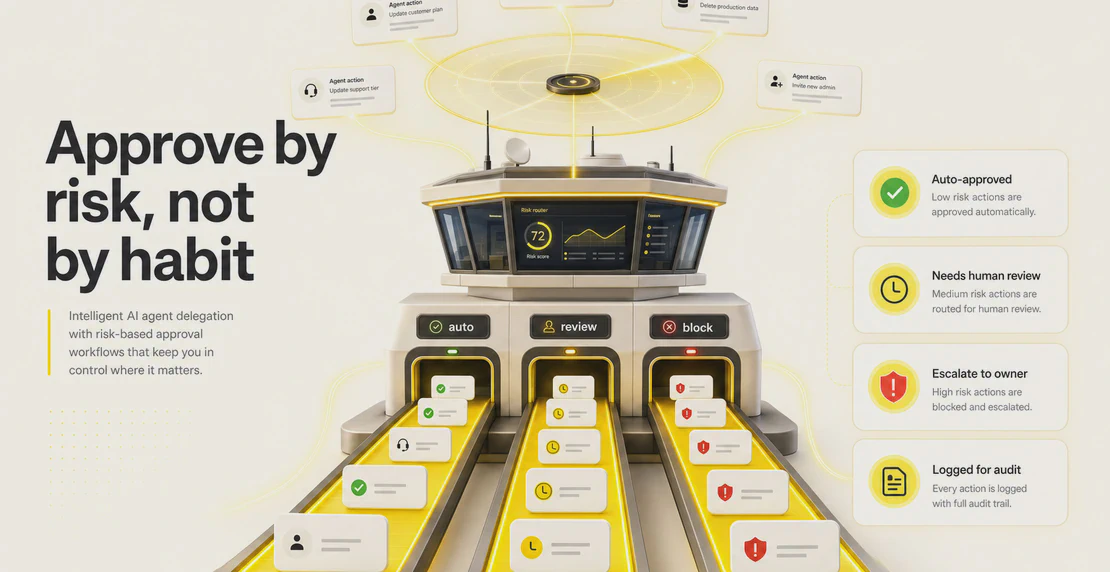
The Approval Bottleneck That's Quietly Killing Your AI Agent ROI
Match each AI agent action to a level of oversight based on its risk and reversibility, and delegation moves fast without losing control.
Read article
Jono Nourse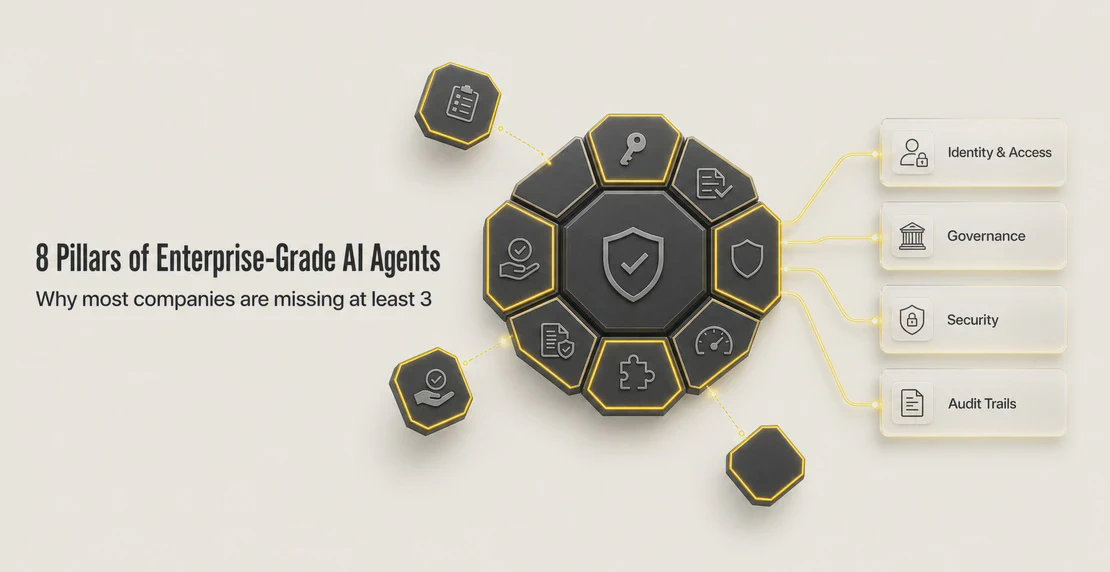
An enterprise-grade AI agent is one you can trust to act on company systems without a human watching every step. That trust rests on eight things working together, not on a better model: controlled identity, governance, security, observability, evaluation, integration boundaries, compliance mapping, and human oversight. Get all eight right and an agent can run real work safely. Miss one and you have a liability with API keys.
This is a practical breakdown of each pillar, what it actually requires, and how it maps to controls you can set up today.
Agents are moving from demos into production faster than most governance functions can keep up.
Gartner forecasts that 40% of enterprise applications will feature task-specific AI agents by the end of 2026, up from less than 5% in 2025. That’s the demand side.
The readiness side is thinner. Deloitte’s State of AI in the Enterprise 2026 found only 21% of organizations have a mature governance model for agentic AI. Writer.com’s research points to the fallout from that gap: data-leak concerns tied to unapproved AI tools, and teams that can’t reliably stop an agent once it’s running.
There’s plenty of pressure to deploy and not much readiness to govern. The eight pillars below close that gap.
Every agent needs its own identity and the narrowest set of permissions that let it do its job.
An agent acting under a shared admin account is untraceable and over-permissioned. The industry term for the alternative is non-human identity: agents get distinct, governed identities rather than borrowing a person’s. Least privilege applies the same way it does for humans, only tighter, because an agent can call an API thousands of times before anyone notices.
In Autohive, access starts with workspace roles and permissions: plan-level RBAC with Owner, Manager, and Member roles, and workspace owners who manage members and their roles. Account security covers email/password login, OAuth 2.0, TOTP-based 2FA, recovery codes, and organization-wide 2FA enforcement, all handled in account settings. Each agent is configured with its own instructions, boundaries, tools, and knowledge sources, so what an agent can touch is defined at build time, not left open.
Governance is knowing which agents exist, who owns them, what they’re allowed to do, and being able to change all of that at scale.
Without it, agents multiply quietly until no one can answer basic questions about them. Mature setups use an agent registry or control plane to track every agent, tier them by risk, and apply policy centrally. High-risk agents get tighter controls than a low-stakes internal helper.
Autohive handles this through per-agent configuration and role-based control. Each agent has a name, description, instructions, guidelines, selected tools, and configured capabilities, set in agent settings, so its scope is explicit and reviewable. Integrations enabled per agent can be turned on or off, with some exposing capability-level toggles for finer control. Owner and Manager roles decide who can make those changes, and managing an agent end to end, from editing through to retirement, follows the same permission model.
Agents introduce attack surfaces that traditional apps don’t have, and the model itself is one of them.
Prompt injection hides instructions in content the agent reads and hijacks its behavior. Context poisoning corrupts the data an agent reasons over. Tool misuse and excessive agency happen when an agent has more power than the task needs and gets talked into using it. OWASP’s work on agentic threats and Anthropic’s framework for safe, trustworthy agents point the same way: design for these from the start, and test against them.
Autohive’s platform security covers the infrastructure layer: TLS 1.2+ with HTTPS and HSTS enforcement, AES-256 encryption at rest, unique encryption keys per workspace and per conversation, AWS hosting with VPC and security group isolation, session validation, and a vulnerability disclosure program. The underlying AWS infrastructure is SOC 2 Type II and ISO 27001 certified. For an overview, see Autohive security. For the full detail, see security and compliance. On the agency side, scoping each agent to only the tools and integrations it needs is the most direct way to limit what a compromised or misled agent can do.
You can’t govern what you can’t see, so every agent action needs to leave a record.
The emerging standard here is OpenTelemetry-style instrumentation applied to agents: traces of each run, logs, and metrics covering cost, latency, and groundedness, plus capture of the reasoning steps behind a decision. The point is being able to answer “what did this agent do, and why” after the fact, and to roll back when needed.
Autohive gives you two records to work from. Plan-level audit logs capture actor details, timestamps, impacted workspaces, and system actions. Scheduled jobs expose execution logs and task history, including run history, execution times, and active or completed status. That covers who did what and when, and how automated jobs actually ran.
An agent that works in a demo and fails in production is worse than no agent. Reliability has to be measured, not assumed.
Strong evaluation combines automated evals with model-based graders, human review of transcripts, A/B testing, and regression testing that catches when a change breaks something that used to work. Anthropic’s guidance on evals for agents makes the case plainly: without a scoring loop, you’re guessing. Production monitoring extends that past launch.
Autohive’s build guidance recommends checking an agent before release: scenario testing, accuracy checks, guideline checks, and tone checks. Shared conversations with agents and colleagues make transcript review a team activity rather than a solo one, so more than one person can catch a problem before it reaches customers.
An agent is only as useful as the systems it can reach, and only as safe as the limits on what it can do there.
Two open standards are shaping this space. The Model Context Protocol (MCP) gives agents a consistent way to access tools and data. Agent-to-agent (A2A) protocols handle coordination between multiple agents. Both matter because they replace one-off integrations with something teams can reason about. Whatever the plumbing, the rule holds: connect broadly, permission narrowly.
Autohive connects agents and workflows to CRM, communication, storage, analytics, project management, development, marketing, finance, and scheduling tools through a no-code connection model. Integrations can be enabled or disabled per agent, and some expose capability-level toggles, so the action boundary is set per connection. Building a workflow links triggers, agents, tools, and destinations, and teams running multiple agents together can define how the work hands off.
Enterprise agents run inside a growing set of legal obligations, and someone has to map controls to each one.
The EU AI Act carries transparency requirements for AI systems. The NIST AI Risk Management Framework offers a structured approach to identifying and managing AI risk. Sector rules add more: DORA for financial services operational resilience, plus data residency, retention, and privacy requirements that vary by jurisdiction. Mapping means showing, per obligation, which control satisfies it.
Autohive documents GDPR-related handling: account deletion, workspace data deletion, privacy rights, and data-subject request handling, set out in the privacy policy. Regulatory mapping beyond that is work you own. The audit logs, integration controls, and role permissions above are the raw material for it.
However capable an agent gets, a person needs a way to approve, pause, and stop it.
This is the pillar teams skip and regret. It means approval gates on consequential actions, escalation paths when an agent hits its limits, and stop controls plus revocation for when something goes wrong. The Writer.com finding about teams unable to halt rogue agents is what happens without it.
Autohive surfaces approval requests through in-app, mobile, and email notifications: in-app action boxes, mobile push, and email alerts, with the option to approve or reject each request. Owners and Managers can revoke access and disable integrations, and scheduled jobs can be reviewed through their run history. Human sign-off sits in the loop by design.
You don’t need all eight pillars mature on day one. You need to start in the right order.
Start with one agent doing one well-scoped job, prove the controls hold, and expand from there. If you’re setting up shop for the first time, the Quickstart guide covers the basics.
Controls, not capability. An enterprise-grade agent has a governed identity, least-privilege access, logging, evaluation, defined action boundaries, and a human able to stop it. The model matters far less than the guardrails around it.
Agents add model-level threats that traditional apps don’t face, like prompt injection and excessive agency, where the agent is talked into misusing legitimate access. You still need the usual encryption and network controls, plus new ones aimed at how the agent reasons and which tools it can call.
No, but you shouldn’t run an agent unattended without identity controls, an audit trail, and a way for a human to intervene. The rest can mature as you scale. Deploying with none of them is how organizations end up in the 79% without mature governance.
It’s the practice of giving each agent its own governed identity instead of letting it act under a human’s account or a shared credential. It makes agent activity traceable and lets you apply least privilege per agent.
Through role-based workspace controls, per-agent configuration of tools and integrations, plan-level audit logs, scheduled-job run history, approval requests across in-app, mobile, and email, and platform security running on SOC 2 Type II and ISO 27001 certified AWS infrastructure. See the security and compliance documentation for the detail.

Written by
Jono is the Marketing Operations Lead at Autohive, bridging the gap between commercial strategy and AI-powered execution. With a passion for building systems that scale, he brings structure to complexity and turns marketing activity into measurable …
Jono NourseMatch each AI agent action to a level of oversight based on its risk and reversibility, and delegation moves fast without losing control.
Read article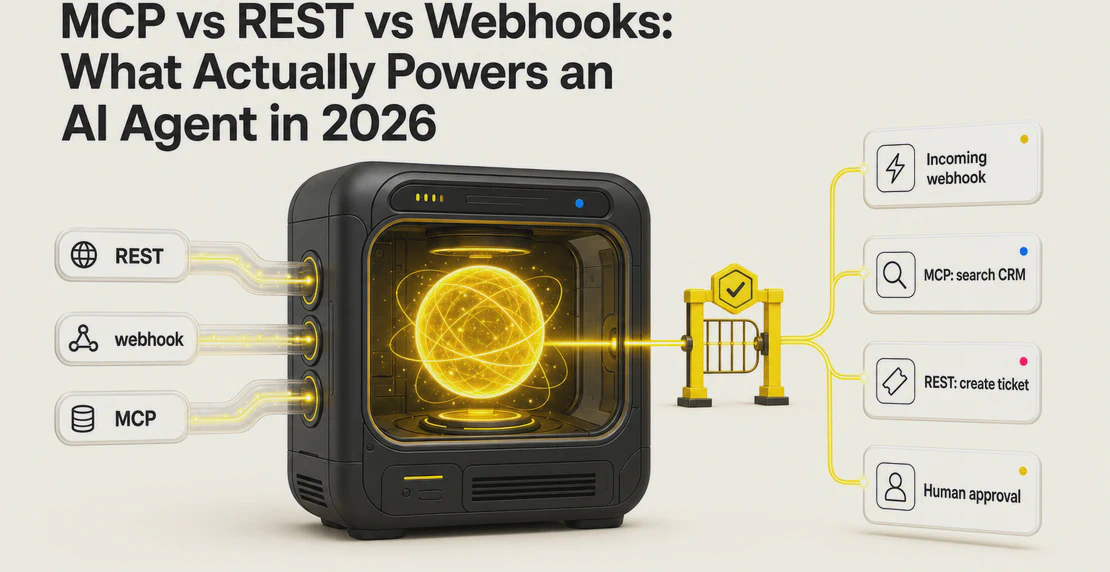 Jono Nourse
REST, webhooks, and MCP each solve a different problem in an AI agent stack: pulling data, reacting to events, and finding tools at runtime. This post …
Read article