Shadow AI is unsanctioned AI tool use by employees, outside IT visibility and governance. Agentic shadow AI is the version that should worry you more: autonomous agents that read files, call integrations, update systems, send messages, and run on a schedule, all without an owner or a control anyone can point to.
The old shadow IT problem was a rogue SaaS subscription. This one acts on your data. An employee pasting a customer list into a chatbot is a leak. An ungoverned agent wired into your CRM, your inbox, and your finance tools is a leak that repeats itself every night at 2am, and nobody signed off on it.
Here is the practical answer, before the detail: you cannot block your way out of this. Blocking every external tool does not remove the demand that created shadow AI. It pushes the work into personal accounts and unowned agents where you have zero visibility. What enterprise IT needs is a sanctioned place for people to build and use agents, paired with identity, scoped permissions, approval gates, and an audit trail. That is a platform decision, not a policy memo.
Shadow AI is already at enterprise scale
Most of your workforce is already doing this. The numbers are not marginal.
- BlackFog’s research with Sapio found 49% of workers use AI tools their employer has not sanctioned, 86% use AI weekly at work, and 51% have connected AI tools to work systems without IT approval.
- The Cloud Security Alliance’s research on unsanctioned AI tool adoption puts the number at eight in ten employees, with unapproved use growing 156% between 2023 and 2025, and 89% of enterprise AI usage invisible to security teams.
- IBM’s research on shadow AI adoption found 80% of US office workers use AI in their roles, but only 22% rely solely on employer-provided tools.
The data going into these tools is the sensitive kind. BlackFog found 33% of employees have entered research or datasets, 27% have shared employee data, and 23% have entered financial information into unsanctioned tools.
The cost is now measured in breaches, not hypotheticals
Shadow AI shows up in breach reports, and it makes them worse.
IBM’s 2025 Cost of a Data Breach Report found one in five organizations had a breach tied specifically to shadow AI, only 37% had a policy to manage or detect it, and high shadow AI use added $670,000 to the average breach cost. Those breaches exposed more personal data and more intellectual property than the typical incident.
IBM’s 2026 Cost of a Data Breach Report shows the trend accelerating. One in four malicious breaches is now AI-enabled, a 56% jump year over year, and AI-enabled breaches average $6 million, roughly a million above the global average.
Two cases make it concrete. In 2023, Samsung engineers pasted proprietary source code and internal meeting notes into ChatGPT, and Samsung banned generative AI tools for staff in response. In May 2026, CB Financial Services became the first public company to file an SEC Form 8-K triggered by unauthorized employee AI use under Item 1.05, rather than an external attack, after an employee ran non-public customer data through an unauthorized AI application. The trigger was not a hacker. It was staff trying to get work done with the wrong tool.
Shadow AI is unmet demand, not bad behavior
People do not reach for unapproved AI to break rules. They reach for it because they need to move faster than the process allows.
Microsoft’s UK research on unsanctioned AI tool use found 41% default to shadow tools because they already use them personally, and 28% say their employer provides no approved option. That second number is the one IT can actually fix. When there is no sanctioned path, the sanctioned path becomes a personal ChatGPT tab.
This is why blocking fails. The demand does not disappear, it relocates to private accounts and disconnected workflows you will never audit. The goal is to redirect that energy into a place you own.
Give people a sanctioned place to build
The single most effective control is offering a better option than the browser tab. A no-code agent creation path lets employees build the agents they need inside an environment IT can see.
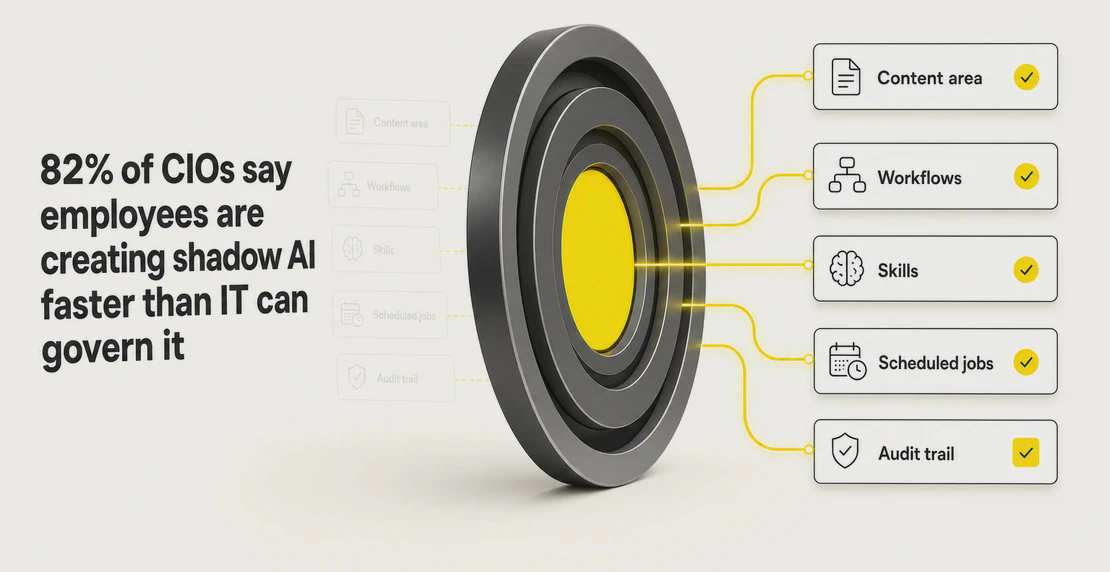
In Autohive, that means Workspaces: visible homes for business work, with personal, private, and shared spaces instead of scattered private accounts. It means a Content area that gives agents shared, approved company context, so people stop pasting the same confidential documents into random prompts. Workflows, Skills, and Scheduled Jobs turn one-off experiments into repeatable processes that live where you can review them.
The Autohive Marketplace covers common use cases with ready-made agents. Custom agents can encode your organization’s actual policies, escalation paths, and risk thresholds, which is where governance stops being abstract and starts being enforced. If you want to see the mechanics, building a custom agent walks through it.
Identity: every agent needs a traceable owner
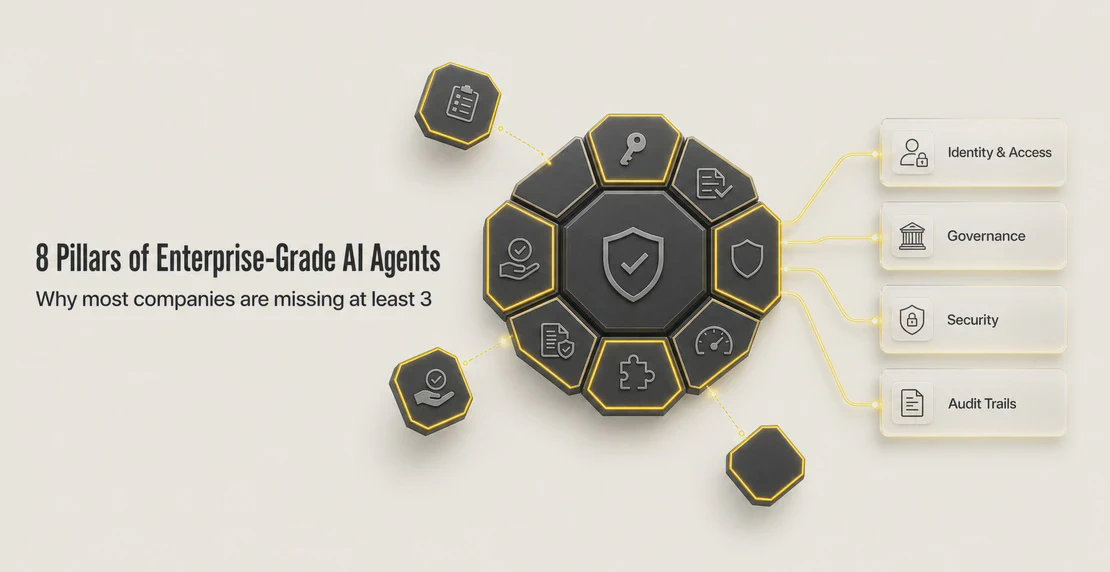
Every agent should map to a named owner, a stated purpose, and a lifecycle review, the basics of properly managing agents. If you cannot answer “who owns this and why does it exist,” it should not be running.
This is the gap most organizations are staring at. The CSA reports 82% of CIOs say employees are creating AI agents faster than IT can govern them, and 53% of organizations have already seen an agent exceed its intended permissions. Gartner forecasts that Fortune 500 companies may run more than 150,000 AI agents by 2028, up from fewer than 15 in 2025. Treat the exact figure as a projection, but the direction is not in doubt.
An agent without an owner is the agentic version of that abandoned admin account nobody deprovisioned. It keeps its access long after anyone remembers what it was for. Strong AI agent governance starts by making ownership non-optional.
Give each agent the narrowest set of tools and integrations it needs, and nothing more. An agent that summarizes support tickets does not need permission to delete records or send external email.
Agents get real work done through tools: connections to your systems that let them read, write, and act. That power is exactly why scope matters. If you are new to how this works, AI agent tools 101 covers how agents actually connect to systems. It is the same discipline enterprises are already building into least-privilege identity controls for AI agents, extended to a new kind of actor that can chain actions together on its own.
Approval gates: stop before the irreversible action
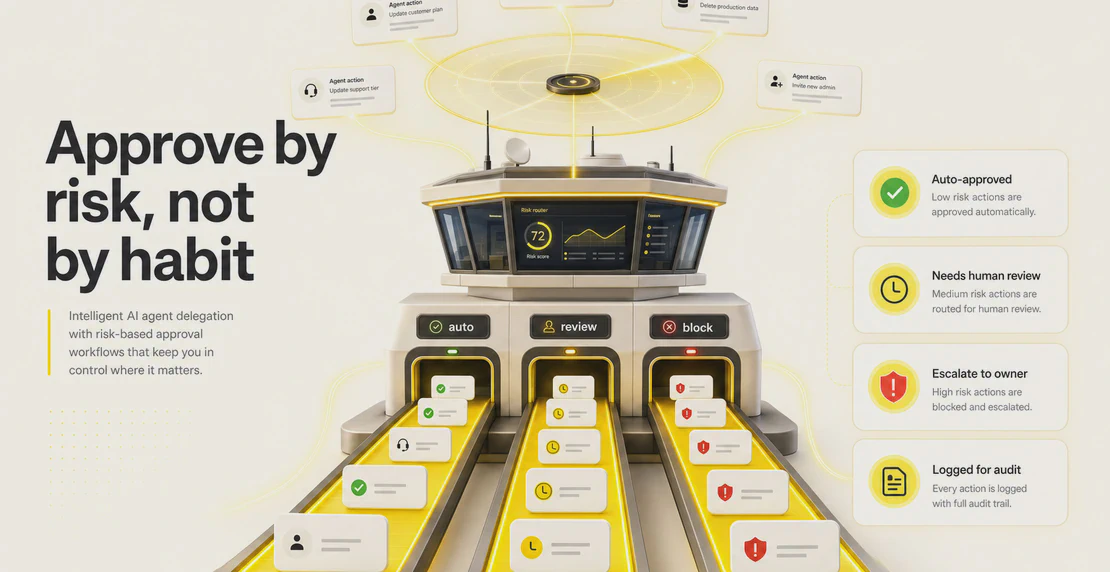
Put a human checkpoint in front of any action with an external side effect: sending, publishing, updating, deleting, paying, or refunding. In Autohive you can require approval before an action runs, so read-only work moves freely and anything that changes the outside world waits for a yes.
The gate is only useful if the reviewer has enough to decide. A good approval request shows the context, the exact payload, the system affected, and the impact of the decision, not just a “do you approve?” with no detail. Done badly, approvals become a rubber stamp or a bottleneck. We wrote about that failure mode in the approval bottleneck that’s quietly killing AI agent ROI, because approval gates before side effects only work when the design respects people’s time.
Evidence: an audit trail you can hand to an auditor
When someone asks what an agent did, you need a record, not a reconstruction. That means an audit log, conversation history, scheduled job logs, and approval records, all attributable to a defined identity.
Runtime visibility matters just as much as the after-the-fact log. Autohive’s Agent Visualizer shows a run as it happened: tool calls, sub-agent handoffs, integration actions, timing, failures, nested calls, branches, and bottlenecks. You can see what an agent did during a run instead of guessing. The audit trail is the record you do not think about until a regulator or an incident forces the question, and by then it is too late to start collecting one.
This is also where frameworks land in practice. ISACA’s guidance on auditing unsanctioned AI tools recommends inventory and discovery, IAM controls scoped to sensitive data, documentation standards, and audit trails aligned to the NIST AI RMF and the EU AI Act. Those requirements assume evidence exists. A governed platform is where it comes from.
Be honest about the boundary, because vendors that oversell it make the problem worse. Autohive’s security and compliance controls give you visibility and control over the agent work carried out inside its governed environment. They do not replace the wider discovery, identity, DLP, and compliance systems that watch activity everywhere else.
No single product solves shadow AI on its own. Most agentic AI risk comes from work happening in places nobody owns. Move that work into an environment with owners, scoped permissions, approvals, and audit trails, and the ungoverned surface that breach reports keep pointing at starts to shrink. For the regulated end of this, AI agents for compliance covers what is ready to use today and what still needs building.
FAQ
What is shadow AI?
Shadow AI is the use of AI tools by employees without IT approval, visibility, or governance. It differs from older shadow IT because AI tools can process, retain, and act on sensitive data rather than just store it.
What is agentic shadow AI?
Agentic shadow AI is ungoverned use of AI agents that can take actions on their own: reading files, calling integrations, updating systems, sending messages, and running scheduled jobs. The risk is higher than with a chatbot because an agent can exceed its intended permissions and repeat actions without a human in the loop.
How is shadow AI different from shadow IT?
Shadow IT is unsanctioned software and services. Shadow AI adds the ability to process and act on your data, and agentic shadow AI adds autonomous actions against connected systems. A rogue SaaS app stores data; a rogue agent uses it.
How much does a shadow AI breach cost?
IBM’s 2025 report found high shadow AI use added $670,000 to the average breach cost, and one in five organizations reported a breach tied specifically to shadow AI. IBM’s 2026 report puts AI-enabled breaches at an average of $6 million, about a million above the global average.
How do you prevent shadow AI?
Give employees a sanctioned way to build and use agents, then govern it: assign every agent a named owner, scope tools to least privilege, require approval before external side effects, and keep an audit trail of every action. Blocking tools alone tends to push the demand into private accounts you cannot see.

Jono Nourse