Jono Nourse
- 17 Jul, 2026
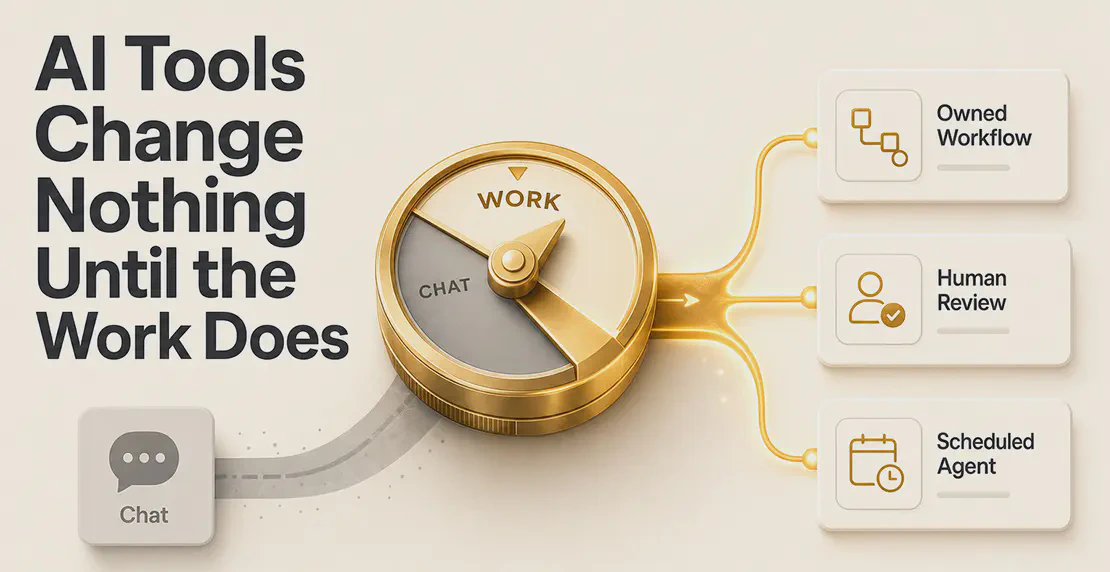
AI Tools Change Nothing Until the Work Does
Most organizations have already bought AI tools and hosted the workshops, but they're still bolting new technology onto old structures. This post …
Read article
Jono Nourse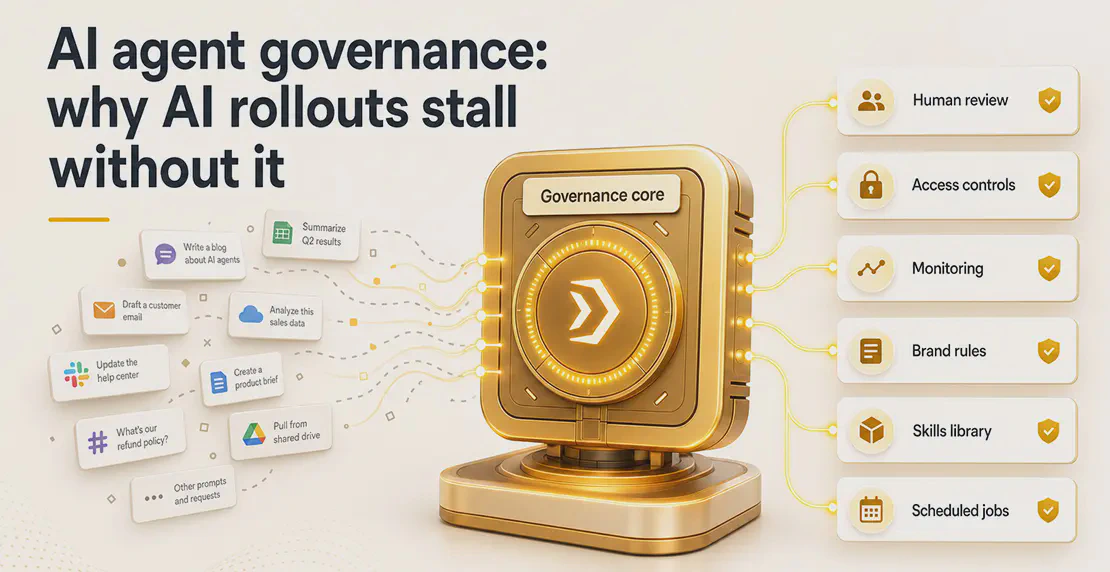
Most organizations don’t have an AI problem. They have a consistency problem.
AI agents are spreading fast. Gartner predicts that 40% of enterprise applications will embed task-specific AI agents by the end of 2026, up from fewer than 5% in 2025. Deloitte found that 74% of organizations plan to use agentic AI within two years, but only 21% have a mature governance model in place for it. The adoption curve is steep, and it keeps getting steeper.
Adoption without structure creates a different kind of mess. When every team member prompts differently, when business context lives in scattered documents and in people’s heads instead of one place, and when no one owns the standards, AI output becomes unpredictable. That’s where ai agent governance comes in. It’s the layer most organizations skip, and it’s a big reason so many AI rollouts stall once the initial excitement fades.
AI agent governance is the set of policies, standards, and controls that determine how AI agents get built, deployed, and used across an organization. It covers what agents can do, what knowledge they draw on, how their outputs get reviewed, and who is accountable when something goes wrong.
IBM describes it as the processes and guardrails that help keep agentic systems safe and ethical. Liminal AI frames it as the policies and controls that align AI use with business goals, regulations, and risk tolerance. Both descriptions point at the same thing: governance is the management layer that sits between “we have AI agents” and “our AI agents reliably do what we need them to do.”
Think of it as an operational discipline, the same way quality control is an operational discipline in manufacturing, or editorial standards are in publishing.
The root cause of inconsistent AI output is almost always the same: context lives in silos, and prompting gets left to individuals.
When someone on your marketing team asks an AI agent to write a product description, they bring their own read on your brand voice, your product positioning, and your customer. When someone on your sales team asks for the same thing, they bring theirs. The agent has no shared reference point, so it produces different output every time. Neither version is wrong exactly. Neither is reliably right either.
AICamp found that 73% of organizations struggle with AI output inconsistency, with increased review time and reduced adoption tied directly to reliability concerns. Strategy.com identified a related problem: inconsistent answers often trace back to business logic embedded across separate tools and conflicting metric definitions. The problem sits in the organization, not in the model.
The cost shows up in a few places. Review cycles get longer because outputs can’t be trusted without checking. Teams quietly go back to doing things manually. Brand voice drifts from one piece of content to the next. Customer-facing content varies in quality depending on who wrote the prompt. And as Dataiku reported, 82% of CIOs agree that employees are creating AI agents and apps faster than IT can govern them, with 54% having already discovered unsanctioned AI use at work. That points to a gap in governance, not in technology.
Good governance doesn’t take a bureaucracy. It takes a handful of things done consistently.
Shared knowledge. The single biggest lever for consistent AI output is giving agents access to the same, authoritative source of truth. Brand guidelines, product documentation, approved messaging, internal procedures, and business context should live in one place agents can draw on, not scattered across email threads and personal drives.
Defined agents. An agent configured with a clear purpose, a defined tone, explicit constraints, and worked examples will produce more consistent output than one that relies entirely on whoever happens to be prompting it. Output quality shouldn’t depend on how skilled the user is at writing prompts.
Repeatable processes. Ad hoc prompting is the enemy of consistency. When AI work is structured as a repeatable workflow rather than a one-off request, the output becomes predictable. The same inputs produce the same quality of output, every time.
Human review where it matters. Governance doesn’t mean removing humans from the loop. It means being deliberate about where human judgment is required. High-stakes outputs, customer-facing content, and anything touching regulated areas should have a review step built in from the start, not bolted on as an afterthought.
Access controls and accountability. Not everyone should be able to modify shared knowledge or reconfigure agents. Role-based access keeps the standards you’ve set from being accidentally overwritten, and gives each part of the system a clear owner.
Monitoring. You can’t govern what you can’t see. Tracking what agents are doing, what outputs they’re producing, and where things go wrong is how governance improves over time instead of just existing on paper. Dataiku’s research found that 75% of CIOs currently lack full real-time visibility into agents running in production.
The gap between governance as a concept and governance as a working system is where most organizations get stuck. The principles are easy to agree on. The implementation is where it gets hard.
Start with knowledge. Before you configure a single agent, decide where your authoritative business context lives. That means consolidating brand guidelines, product information, approved procedures, and any other reference material agents should draw on. In Autohive, the Content Hub serves this function: a shared knowledge base that agents across your organization can pull from, so every agent works from the same foundation instead of each person’s individual understanding.
Next, configure your agents deliberately. A well-built agent encodes purpose, tone, constraints, and examples, so output quality doesn’t depend entirely on how each person prompts. You can build a custom agent that reflects your standards and share it across teams, instead of leaving each person to build their own from scratch.
Then standardize the work itself. The most durable form of governance is a workflow: a defined sequence of steps that turns AI work into a repeatable process. Build a workflow in Autohive and the same quality of output becomes the default, not the exception. Some of that work doesn’t need a person to trigger it at all. Weekly reports, recurring content refreshes, and regular data pulls can run as scheduled jobs, so the standard applies whether or not someone remembers to kick it off.
One of the most practical mechanisms for ai workflow standardization at scale is reusable knowledge packaged as Skills. Skills let a team define a standard once, whether that’s a research methodology, a writing style, a data analysis approach, or a set of output rules, and make it available to any agent that needs it. Instead of every agent reinventing the wheel, or every person prompting from scratch, the expertise gets encoded once and shared. This is exactly how Autohive Skills create consistent AI output across teams: the standard is defined once and applied everywhere.
Finally, build review into the process. Autohive’s multi-agent conversations and @mention features let you route outputs to a human reviewer before they go anywhere. That’s not about distrust. It’s about having a clear, auditable step where judgment gets applied.
If your organization is already using AI agents, governance is probably overdue. If you’re just starting to roll them out, building governance in from the beginning is far easier than retrofitting it later.
A practical starting point: audit what’s already happening. Where are AI agents being used? What knowledge are they drawing on? Who configured them, and to what standard? Dataiku’s finding that 54% of organizations have discovered unsanctioned AI use suggests the answer is usually “more than you think, and less consistently than you’d like.”
From there, the sequence is fairly linear: centralize your knowledge, configure agents to a defined standard, turn recurring AI work into workflows, package expertise as reusable Skills, add human review where the stakes are high, and monitor outputs so you can see what’s working and what isn’t.
None of this requires a dedicated AI governance team or a six-month project. It requires treating AI agents like any other business process: clear ownership, defined standards, and a feedback loop.
The organizations that get this right won’t just have better AI output. They’ll have AI that scales, because quality doesn’t degrade as more people use it and more agents get added. That’s the point of governance: consistency as a business outcome, not control for its own sake.
Deloitte’s finding is worth sitting with: 74% of organizations plan to use agentic AI within two years, but only 21% have a mature governance model for agentic systems. That’s a significant gap between adoption intent and operational readiness.
The organizations that close that gap first will have a real advantage, and it won’t come from having better AI models. It’ll come from having built the layer that makes AI reliable at scale. Governance gets treated like the boring part of AI adoption, but it’s the part that determines whether the investment pays off.
If you’re rolling out AI agents and the AI context gap is already showing up in inconsistent outputs and frustrated teams, better prompting won’t fix it. Better governance will.
If you want to see what this looks like in practice, start building with Autohive: shared knowledge, custom agents, and reusable Skills that turn ad hoc AI use into a system your whole organization can rely on.

Written by
Jono is the Marketing Operations Lead at Autohive, bridging the gap between commercial strategy and AI-powered execution. With a passion for building systems that scale, he brings structure to complexity and turns marketing activity into measurable …
Jono NourseMost organizations have already bought AI tools and hosted the workshops, but they're still bolting new technology onto old structures. This post …
Read article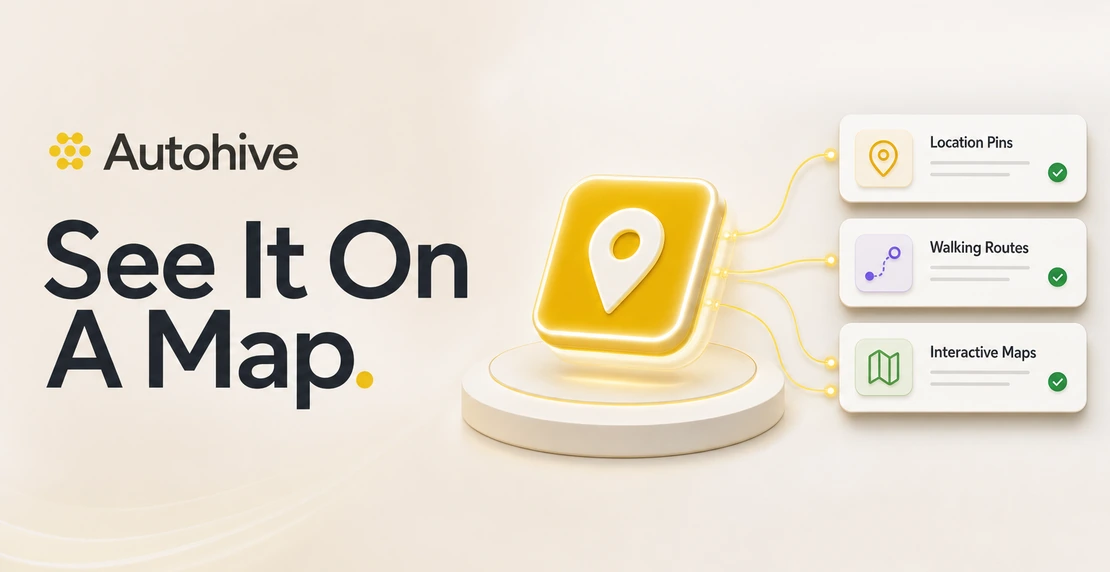
 Andre Lepardo
Ask an Autohive agent about locations and it can answer with an interactive map in the conversation, including labelled pins, status colors, and …
Read article