Jono Nourse
- 20 Aug, 2026
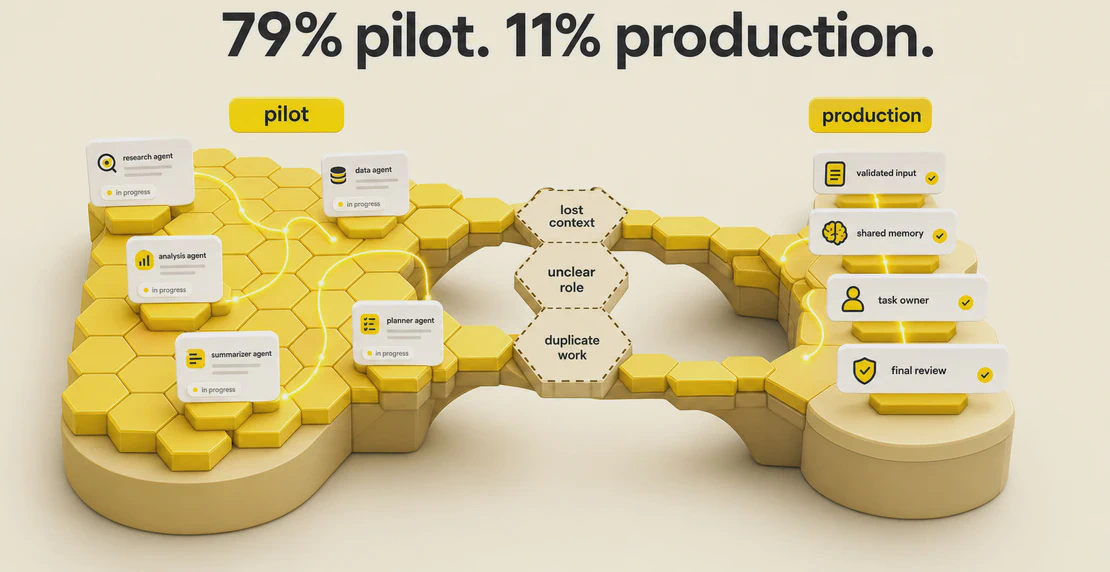
79% of Companies Use AI Agents. Only 11% Reach Production. What Separates Them.
Multi-agent AI systems succeed or fail based on how cleanly agents hand off work, not on which model powers them.
Read article
Jono Nourse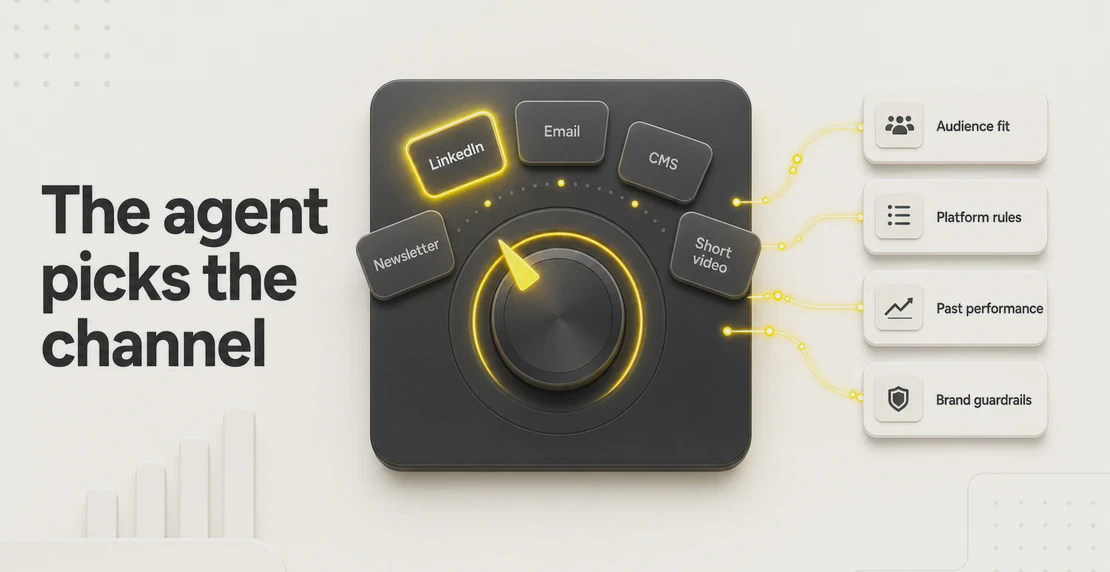
Most marketing teams already schedule posts in advance. That part got solved a decade ago. What’s changed is that the scheduling tool no longer just fires a queue at preset times. It can decide what to post, where, in what format, and when, then check how the post did and adjust the next one.
That’s the practical difference between a scheduler and an AI agent for content distribution. A scheduler follows rules you set. An agent works toward an outcome you set. You define the goal (get this webinar in front of the right people on the right channels) and the guardrails (stay on brand, don’t post the same clip three times), and the agent plans the rest.
This is happening at scale, not in pilots. As of Q1 2026, 87% of marketers use generative AI in at least one recurring workflow, according to Salesforce’s State of Marketing 2026. The same report found that 34% of enterprise marketing teams now run at least one autonomous agent in production, up from 14% at the end of 2025. RevSure and Ascend2 put the figure higher, with 76% of organizations deploying agentic AI somewhere across marketing, sales, or RevOps.
Strip away the framing and a content distribution agent handles a handful of concrete jobs.
Scheduling across systems. The agent uses API access to your CMS and social accounts to publish at optimal times, staggered for timezones. A post that goes live at 9am in New York can trail an hour behind for a London segment without you building two separate queues.
Channel selection. This is where an agent earns its keep. It picks channels based on where your audience actually engages, what each platform allows, and how similar content performed before. It also rewrites for the platform rather than copy-pasting. X wants short. LinkedIn can carry a longer, insight-led post. Instagram is visual, TikTok and YouTube Shorts need native short-form treatment, and newsletters need segmentation and send timing. A good agent applies those rules without being told each time.
Repurposing long-form. One webinar, blog, podcast, whitepaper, or report can become a stack of platform-native assets. MindStudio estimates a single long-form piece can yield 15 or more distribution-ready assets. The distinction that matters: AI content repurposing isn’t manual shortening. Instead of trimming a blog into a caption, the agent reinterprets the core argument and rewrites it natively for each channel.
Republishing and refreshing. Agents check analytics, find pages that are sliding, update the data, rewrite the stale sections, and republish to recover rankings. It’s unglamorous work that teams rarely get to, which is exactly why handing it to an agent pays off.
Email and newsletter variants. The agent builds versions per segment using engagement history and send-time performance, so a launch email that works for power users isn’t the same one that lands with lapsed subscribers.
Coordination. Underneath all of it, the agent moves content between your CMS, social platforms, analytics tools, CRM, and automation stack so the pieces stay in sync.
The examples are more useful than the theory.
Booking.com ran Sprinklr AI across more than 9,500 TikTok comments in 60 days, tagging them by sentiment and intent, routing the insights to the right teams, and cutting 17-plus hours of manual moderation. Corning used AI-driven Smart Bidding and Automated Pacing on Sprinklr for LinkedIn campaigns and saw a 124% jump in website visits with a 55% drop in cost per acquisition, in a two-week pilot. Trivago used AI to localize a rebrand ad into more than 10 languages, then pushed the same approach out to 20 markets.
Smaller operators are pulling similar results from stitched-together tools. One newsletter creator wired up Make, n8n, Zapier, Claude, GPT, Notion, Canva, ElevenLabs, and NotebookLM to monitor 50-plus sources, spin newsletters into social posts, and generate audio versions. Weekly research and distribution time dropped from 10-plus hours to 4, and the newsletter grew to 4,000 subscribers in four months. On the publishing side, WordPress workflows built on Claude, ChatGPT, and MCP-compatible agents are pushing 30-plus SEO articles a month, attaching media, setting categories, and scheduling the publish date. A Reddit practitioner built a working social posting agent in three hours by feeding Claude writing samples and audience data, generating a week of posts, and scheduling them through Zapier.
Vendors have folded this into their platforms too. HubSpot’s Breeze agents draft content, social captions, and knowledge base articles from a single prompt, and cut production time by up to 70% in beta tests.
The aggregate numbers back up the anecdotes. Marketers save around 6.1 hours per week using AI tools (HubSpot AI Trends 2026), and Vellum puts the typical saving at 5 to 10 hours per deployed agent. Companies using AI publish 42% more content per month (Averi), and AI-driven campaigns have reported 22% higher ROI, 32% more conversions, and 29% lower customer acquisition costs in McKinsey summaries. Given that 72% of marketers already republish across at least three platforms (Sprout Social) and the average social user touches 6.8 platforms a month (DataReportal), the manual version of this work doesn’t scale. The agent version does.
The building blocks map onto this work fairly directly.
Scheduled Jobs run an agent on a cadence you pick: hourly, daily, weekly, monthly, or something custom. A documented example is a weekly competitor social briefing dropped into Slack, and the same pattern covers recurring distribution runs like a Monday-morning repurposing pass or a monthly content refresh sweep.
The Workflow Builder connects agents and integrations into multi-step sequences with drag and drop. This is the piece that turns one source asset into LinkedIn, email, Slack, CMS, and social variants, routing each adapted output to its own destination. If you want the ready-made version of that idea, the Agent Creator guide walks through a Content Multiplier agent as a worked example: you describe wanting an agent that produces and delivers posts to LinkedIn, and the system fills in the name, instructions, integrations, and settings for you.
The integration coverage is what makes the channel-selection piece real: social channels (Facebook, Instagram, LinkedIn, X, TikTok, YouTube, Reddit), CMS and publishing (Ghost, Substack, Notion), email (Mailchimp, ActiveCampaign, Klaviyo, HubSpot), team channels (Slack, Discord, Teams), content creation (Canva, HeyGen, ElevenLabs, Grammarly), and analytics (Google Analytics, Search Console, Looker, Power BI). Those analytics connections matter, because performance-led channel selection isn’t automatic. You design it into a custom agent or workflow using the analytics data those integrations feed in.
For the human side, Autohive supports multiple agents working in one shared thread, so a research agent, a writer, and a publisher can hand off in sequence while you keep oversight through @mentions and team review. Brand guidelines, content calendars, and approved assets live in Workspace Content, where agents can pull them in through retrieval to stay on voice. If you’re building from zero, How to Build a Custom Agent and Set Up Your Multi-Agent AI Dream Team are the two guides to start with, and How to Automate Jobs covers the scheduled-run side.
Two honest caveats. There are no pre-built content distribution agents sitting in the Autohive Marketplace yet, so this is a build-it-yourself setup for now. And approval today runs through @mentions rather than a formal approval node in the workflow, so build human sign-off into your process deliberately rather than assume a gate exists.
The failure data is worth reading before you start, because plenty of teams get this wrong.
Around 29% of attempted agent deployments get abandoned inside 90 days. The top reasons aren’t technical: unclear success criteria, poor tool or data access, and brand-voice drift. Gartner predicts more than 40% of agentic AI projects will be canceled by 2027 for the same cluster of causes: poor data, weak tooling, and missing human oversight. And trust is still shallow, with only 13% of marketers willing to act on AI insights without checking them first.
The platform rules bite too. TikTok, Instagram Reels, and YouTube Shorts detect reused video assets, and a visible watermark from another platform can cut reach by 40 to 60%, according to Conbersa. An agent that blindly cross-posts the same clip everywhere will quietly throttle your own reach. This is the argument for native rewriting over duplication, and for giving the agent explicit channel rules rather than hoping it infers them.
The teams that make it work share a few habits. They define what success looks like in numbers before switching anything on. They give the agent real access to analytics and the accounts it needs. They write down the channel rules and brand voice instead of leaving them implicit. And they keep a human approval step in the loop, because an agent that publishes 42% more content also publishes 42% more mistakes if nobody’s watching.
Start with one job. Pick the repurposing pass, or the weekly refresh sweep, or the LinkedIn-plus-newsletter split from a single source piece. Get it reliable, then add the next channel. That path avoids most of the 29%.
Ready to build one? Create your first agent and start with a single distribution job.

Written by
Jono is the Marketing Operations Lead at Autohive, bridging the gap between commercial strategy and AI-powered execution. With a passion for building systems that scale, he brings structure to complexity and turns marketing activity into measurable …
Jono NourseMulti-agent AI systems succeed or fail based on how cleanly agents hand off work, not on which model powers them.
Read article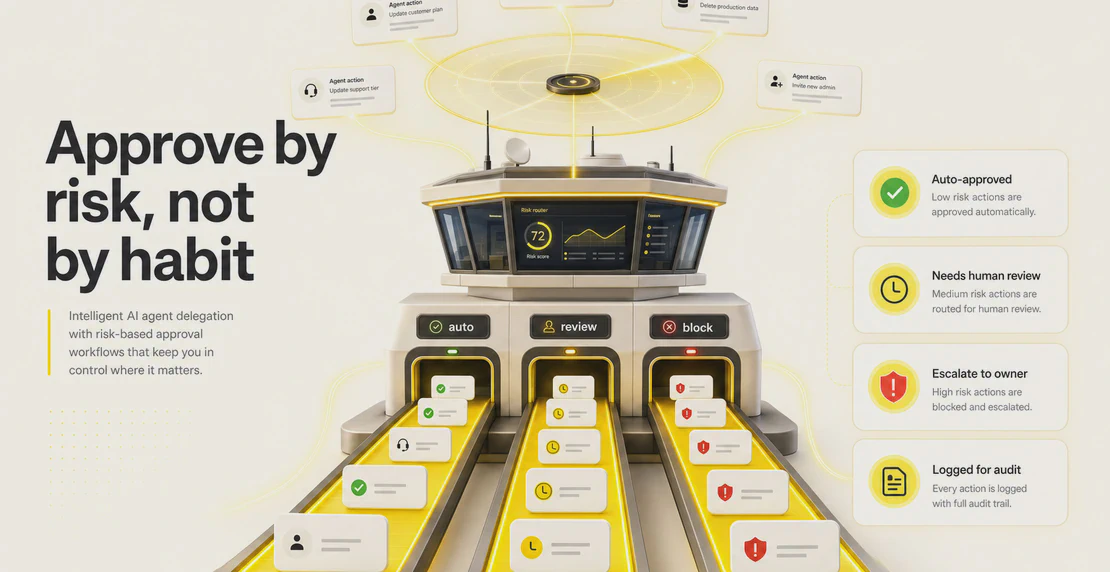 Jono Nourse
Match each AI agent action to a level of oversight based on its risk and reversibility, and delegation moves fast without losing control.
Read article