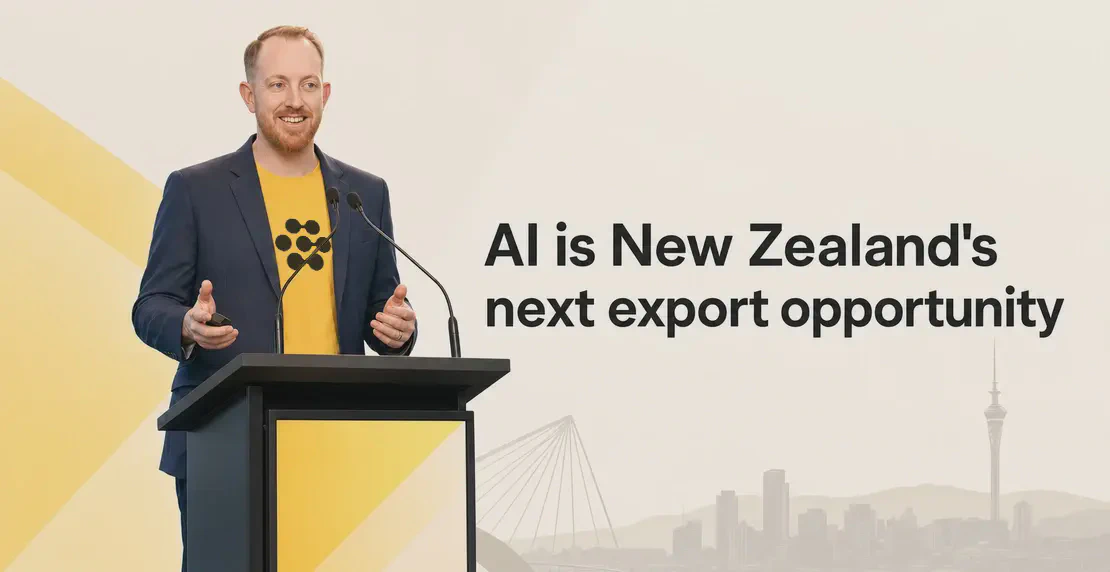
Closing the Aotearoa AI Summit in Wellington, Autohive co-founder and CEO JD Trask made the case that New Zealand is spending its time on the wrong conversation. While the rest of the world builds, we are still holding steering group meetings about governance.
His argument is that our economy is unusually well placed for what is coming, that being a nation of small businesses has turned from a weakness into an advantage, and that the real risk is not AI itself but failing to take up the opportunity in front of us.
The full talk is below, along with the transcript.
Why we should aim higher than Singapore
Kia ora, everybody. Thank you very much for coming along today and to this event. It’s awesome to have an AI event in Wellington. Don’t have to travel for it, which is great. As mentioned, my name is John Daniel Trask. Everybody just calls me JD, and I have built several companies over the years.
Raygun is our primary business. I’ll mention that in the talk today. But we also built AI systems to help us in running our business. And then when people doubted why we were seeing so much benefit from AI, not believing us, we showed them what we built, and they started saying, “Well, can I get that in my business too?”
So we ended up making a whole new company. It’s now been in market for over a year. There’s thousands and thousands of users on the platform. So we’re an example of actually leaning into AI pretty heavily. And I wanted to talk a little bit about the opportunity around AI for New Zealand.
One of the things we hear a lot about here in New Zealand is why can’t we be more like Singapore? My argument is that when it comes to AI, we should elevate our ambition, and we should be thinking, how could we make it so Singapore wants to be more like us? And I’ll be upfront, it probably involves a shitload of data centers.
The point is, we’re not going to get there by spending all of our time talking about AI governance, AI safety, and all of the risks and things to wring our hands about. This talk is about the opportunity of AI. It is not the talk about, oh my God, be terrified. In fact, probably rude of me to say, it worries me when I hear people going, “Oh my gosh, the burnout risks and all this.”
The word is opportunity. The word is not risk. The risk is that you don’t take up the opportunity. And so I want us to shift our thinking as a country, otherwise we’ll be sitting here in five years’ time still talking about governance while we hand all our money to OpenAI, Anthropic and the mega techs.
Software overcomes the tyranny of distance
I’ve long been a nerd, since I was about eight years old writing code, and I’ve long been a proponent of exports. I’m not going to get too heavily into politics today. Suffice it to say, if the country wants to do well, it needs to sell more to the world than it buys from the world. If more money comes in than goes out, there’s more money in New Zealand, everybody gets richer.
I used to say to plenty of people in government, we need to lean in on software. Software overcomes one of our major blockers to success, which is that we are a long way from anywhere. It’s one of our greatest strengths, but it’s an economic rod for our own back. If I want to chop down trees and send planks to the other side of the world, it’s going to take months. It ties up assets. It’s wasteful. It’s not green.
It takes me milliseconds to get my products to market if it’s digital. It doesn’t burn up the environment. AI is going to allow us to double down on the fact that we can remove the tyranny of distance from one of our biggest blockers.
When we look at the country, we need to think, what are our strengths? We have a very educated populace. We have a bunch of universities. We have smart people. We actually have, frankly, enough money, and I’ll come to what we’re missing out on shortly.
Our biggest industries are not the ones at risk
A couple of things I want to emphasize as strengths for New Zealand. A lot of the time in the tech industry there’s talk about how we become the biggest industry in New Zealand. And there are a lot of conversations where people believe we shouldn’t be doing as much farming and things like that.
But I want to make the argument that New Zealand is in one of the best positions for AI. Firstly, our biggest export industry is primary industry, food. AI is not replacing food. We all have to eat, therefore our biggest export category is actually somewhat immune from AI disruption. In fact it may just become more effective with AI.
We see this with brands in New Zealand like Halter building two billion dollar businesses here, coupling AI and technology and farming. So our biggest industry is not going to get wrecked.
Our second industry is tourism. As we get to the point where we can free up more human time, one thing that’s not replaced by AI is experiences, tourism, the opportunity to go and see these beautiful scenes. So the good news is our second biggest industry is also not going to be heavily disrupted, and in fact may slowly get more tailwinds due to AI.
But that brings us to our number three, number four category, which is tech or intangibles. Software, services and IP. This is where we need to double down, and there’s a reason tech is that high in the export categories. It’s because of what I said earlier. Time to market is low. You don’t have a high cost of capital to get started. We have smart people. All of these things exist, so it’s no wonder that category roared and took off.
However, our limiting factor is that we are missing out on ambition, we are missing out on leadership, and we have very low willingness to take a risk.
So we’re sitting here watching this massive industry taking off. We’re now three and a half years into it, and there’s almost nobody taking advantage of it. That’s what we’re missing at the moment. And I don’t mean to cause offense, but the more we sit around talking about social responsibility, burnout and AI ethics, it’s not that they don’t matter, but do you know how long we spent on that at Raygun? It was a bullet point in a leadership meeting. The decision was made, and we moved on. And that’s why we now have two companies and are exporting and helping drive New Zealand forward.
So rather than sitting on the side of the pool watching everybody else have a fun time, let’s strip down and jump in.
AI is going to be bigger than electricity
I want to use the analogy of electricity, which I’ve been citing a few times because I honest to God believe AI is going to be bigger than electricity. Everybody right now is watching AI and paying attention to the OpenAIs of the world and the Anthropics, and they’re going, they’re going to end up taking everything.
And right now they will. However, if we look at electricity, look at the room you’re in. Now, don’t get me wrong, Contact Energy is probably making some good money out of today. But the light bulbs, there’s a company that makes light bulbs. There’s a company that made this microphone. There’s a huge company that made this laptop. The same company makes your phones.
Electricity is all around us, and it’s not that we focus on electricity generation all the time, it’s how it is implicated into every single thing that we do in our society. AI is going to do the same thing, and sometimes we call that the application layer, the bit that sits on top of the models.
There is so much opportunity in that space that every single person in this room could theoretically start an exporting company and probably build something big and still not run into each other as a competitor. There is so much opportunity right now. So don’t get bogged down in AI thinking about models.
For example, I don’t think New Zealand should build a model. I really don’t. I think if we were to do sovereign AI, we should build a lot of friendly data centers, we should fine-tune some Chinese open source models to introduce some of our local concerns better, and we should run that and make it available to everybody in New Zealand.
To that end, I felt very clever earlier this year because I was asked by New Zealand First to come and talk to them about AI policy. I said one of the things I’ve not seen many countries worry about is when do export controls go on intelligence? And it was about three months later that the US government cut [CHECK NAME] off from the world. That problem will get worse, and we’re still sitting here talking about how we’re scared of it. We are still having 2023 conversations. We need to move on.
Small has become a superpower
Another strength we have is that we are a nation of small businesses. Small has become a superpower, and this is something I find both fascinating and infuriating about AI, that almost every single view I had got flipped on its head.
It used to be that if you were Microsoft and you had two hundred and fifty thousand employees, that was part of your moat. You had a quarter of a million people working for you.
Who here uses Copilot? What made you choose the company that’s fucking up AI the most? If your hand went up, you’re one of those people who chose IBM in 1995. It’s the lazy choice.
This is true because of what’s happening at Microsoft, and by the way this is happening at Amazon and it’s happening at Meta. Quarterly layoffs. Those guys know they don’t need two hundred and fifty thousand staff anymore. They know that in twenty years’ time they probably need ten thousand people to run Microsoft.
What’s happening every quarter? Layoffs. What does that do? Destroys culture. What does a broken culture do? Doesn’t innovate. What are they doing? They’re losing. We’re all watching them lose, and they’re trapped in this doom loop where they know they’ve got to slim down, they know they’ve got to make these changes, but how do they do it?
We are a country that can now say, isn’t it great, we’re all small businesses. We don’t have to slim down. In fact, that is my argument for Kiwis. There will be job displacement, but I say displacement because it’s about change. It’s not about no jobs. And the other point is that we don’t have to go through the same types of cycles those larger companies do.
A bigger company has more people who can say no. I keep hearing about taking people on the journey. It’s three and a half bloody years. If they’re not on the journey yet, kick them off the boat. There’s always some rational excuse for why we should go slow, and then we go, God, what do you think about this cost of living crisis? Well, maybe we could build something and sell it to the world.
I would encourage all of us as small businesses to be thinking about exporting what we’re doing as well. As we start automating processes, as we start doing things better, there is no reason to limit your thinking to New Zealand, because you don’t need to go and get ten thousand staff anymore. You can do it as a small group. Twenty people, thirty people, a hundred people. One of our weaknesses has become a strength.
If your employer isn’t pushing AI, they’re making you unemployable
I almost missed this one. If you work at a company with more than a thousand people, run. I mean it.
There’s a direct pattern here, and I’ve had it at this event, where people are saying, what do I do if my organization is not pushing AI hard and I can’t get access to these tools? And it’s like, well, quit. And people go, I can’t, what do you mean quit? And I say, well, you know that employer is currently making you unemployable, right? If you applied at one of my companies and said, “I haven’t really done much but put a couple of prompts into Copilot,” you wouldn’t make it to the interview.
That is happening right now, and those larger organizations are absolutely sitting there thinking they can reduce their headcount, so you should leave now before you’re pushed.
I know that’s scary. I’m scared of AI to a degree, but the point I make about it is that when you’re afraid of something, the best thing you can do is learn as much about it as you can. Some of the things you’re afraid of won’t matter. Some of the things you weren’t even aware of might be the things to be afraid of, but you’ll now understand it. An educated person in an adversarial situation has an advantage. So don’t put your head in the ground.
The Chief AI Officer is an anti-pattern
I got asked by a lot of people beforehand whether I was going to have a controversial talk. In fact I got asked it so much I started to worry I was going to have to really dial it up.
Who here is in charge of AI? Your title would be something like Head of AI or AI Strategy. Anybody?
Anyone?
Yeah, I’d be worried about putting my hand up too. Total anti-pattern.
You have a Chief AI Officer? Fake job. Not a real job. Or at least ask the question, does your Chief AI Officer have lunch with your Chief Electricity Officer? If the answer is no, it’s a bullshit job.
The important thing is that you have to lead from the front. In my businesses I was the guy who came in at the start of 2023 and said, we’ve got to turn this whole place around, and the first thing I’m going to do is invest in you. We are going to pause the company for a week. We are going to build agents.
We were building agents, including on open source models, in May 2023. We were automating parts of our business then, and it meant I had to do the leading. It didn’t mean I necessarily knew the most. It just meant I had to show I was willing to make the same mistakes, and that I was willing to put money behind it.
When I hear that MBIE, for example, rations Copilot licenses, do they know what the I in their name stands for? It’s ridiculous. Utterly ridiculous.
So you need top-down. It cannot be that you anoint somebody who’s going to solve it. That is how you have a complete failure of AI rollout, because it’s an everybody technology.
It’s not about cost cutting
It’s also not actually about cost cutting. There are plenty of ways you can cut costs. We’ve done that in our business with AI for sure. But that’s not the opportunity, and this talk is about the opportunity.
As I said, we’re already small businesses. You don’t really need to be thinking about layoffs. What you want to be thinking about is what would this business do with fifty percent more headcount? And the answer will be x, y, z. Might be a new product, a new market. Then it’s a case of getting AI doing that part. You might not necessarily hire more, but you can scale the ambition with AI.
For New Zealand, that’s a great thing. We’re not sitting in Microsoft’s shoes figuring out how we’re going to lay off another twelve thousand people. We’re thinking, how will we do more with AI with the people we have?
Motion is not progress
I’m observing this a lot. We’ve been in market now with Autohive for over a year, and I’m still talking to companies that are still having their committee meetings. They’re still setting up steering groups. They’re still talking about governance. Nothing’s changed in their business. Their customers haven’t got a better product. They’re just wasting time.
My encouragement is that you should flip every single thing you’re doing with AI into thirty-day return on investment pilot programs. It needs to be owned from the top. That doesn’t mean the top has to do the work. Often I’m finding a C-level coupled with one of those new grads is a dynamic combo.
And money is the metric. I know New Zealanders don’t like to talk about money unless it’s about taxing ourselves more, but money is the measure in business. Is it actually winning or losing?
So we want to ship things, and once we measure that project, did it work? If so, scale it up. If it didn’t, kill it off and run the next test.
Go and do some doing. I know it’s a tired analogy and you’ve all heard it before, but it’s the same thing as teenagers and sex. You can go to as many sex conferences as you want. If you’re not having it, you’re not doing it. Same thing with AI. Go do some doing, and you will be streets ahead of the people who are just talking.
We are the evidence to the contrary
There is a pattern to this, and again, I know there will be some naysayers. I am your evidence to the contrary.
We built a business called Raygun in 2012. It is ninety-three percent export-based. You can imagine we almost have a virtual pipe of money that goes down to Courtney Place, where our office is just over there, flooding in millions of dollars that we spend in our local economy. I always make the joke that we’re single-handedly keeping that KFC on Courtney Place open.
What did we do with it? We took some of that money and we optimized the Raygun business with AI. And as I said, we then had demand, so we turned it into a product. Now we’re selling that and making more money for the country.
How did we manage to build a whole company, take it to market, do a launch event, get thousands of users, and I’m still talking to people who are saying, “I hope my boss will get me that license”? That is a disgrace for our country. We can and should be doing better.
Taking the money you’re making now, building new things and selling them back to the world is how we lift this country up.
What good looks like
I want to flip to a brief demo. I’m not really here to talk about Autohive, but I wanted to give you an example.
There was a great question earlier about what successful AI looks like. Two things we have in our business. One is that we want to get to the point where more work happens when we’re not at work than when we are at work. We’ve literally had AI systems optimize one of our products and reduce the cost to serve by ninety-five percent, and it did it overnight while the engineers were sleeping. That means we can lower the cost of that product to customers and make it more price effective in the market.
I also agree with the earlier panel that the long-term quid pro quo is to work less. Admittedly Autohive is a young business, so I’ve got a lot to grow, and you can help me out by becoming a customer. But I said to the team, the goal is that if we can get to certain points we should start shortening the workday. That should be what employees get in return, because if we can put out fifty times the amount of work, does it really matter if you trim the workday by ten percent?
And honestly, being a bit of a nerd, that’s what I want too. That’s why when this stuff came along and I already owned a business, I was like, yes, how do I make this happen here? At the time I thought, ChatGPT isn’t going to cut it, I’m going to have to build.
So we get to the point where if there is a thing we need to do in the business, we should just be able to communicate the thing and have Autohive help us optimize it.
I’ve got a short video here that I played at a hospitality conference a while ago. This was one where somebody said they are a chain of hotels and they get a lot of Google Business reviews. This is just the build process. We go into Autohive, we go to Agent Creator, and I say, can you go and look at our Google Business reviews, pick the answers, draft me a reply and let me approve them going up? Follow this tone of voice.
I have to speed the video up because token generation is a bit slow. But you’ll see, it says okay, I’ve found that we need the Google integration, I’m going to write the main system prompt for the agent, I’ve created an avatar for it. It does the whole thing for you. Then we click create and we’re pretty much done.
In this case I worked with one of the hospitality operators when we set this up, and they said, I spend an hour every morning going through this, and now I just come in and it says, here are your drafted replies, and I say yes, yes, no. In particular it was handling complaints.
I don’t want to run over, so I won’t keep demoing. But the goal with AI should be getting to the point where if you can explain the problem you want solved, it solves it. And yes, there is a human in the loop. They still have a human verifying what goes out, but the human is no longer having to dredge through that data.
That’s the sort of thing where, and I know I was being cheeky earlier, when I hear about things like burnout I look at this and think, surely the burnout was coming from needless toil work that bored you to death, rather than from the success of achieving the goal.
That was the vision behind Autohive. It’s part of what I’m trying to do to elevate New Zealand in the global market and help improve the country.
We could sit here and talk all day about how the government should make jobs. The government doesn’t make real jobs. It’s everybody outside government who actually pays all the taxes. We create the jobs. So we’ve got to take some ownership. We’ve got to demonstrate that leadership, that ambition, and that goal to be successful.
What to take away
A couple of points to take away.
Own the outcome from the top. If your CEO isn’t doing anything with AI, quit. Go somewhere that’s not about to get destroyed.
Replace the theater and the looks-like-work with an actual pilot. Put proper funding into it. Sitting around yakking is not going to do anything.
There’s a great movie back in the day called Van Wilder: Party Liaison, and he has a line in it where he says worrying is like a rocking chair, it gives you something to do but you don’t get anywhere. And I thought, that describes about eighty percent of the AI rollouts in this country. Lots of talking, not a lot of AI.
And design for export. Let’s get some money from the rest of the world into the country. We have the smart people. We have the digital infrastructure. We have the capability. We’ve just got to stop hand-wringing.
Take the red pill
So I come to you with an offer.
You can take the blue pill, go back to sleep and keep debating AI governance, social responsibility and ethics. You can keep postponing doing any work.
Or you come out to the Autohive stand. There are some beautiful people out there. We only employ beautiful people. Talk to the team. They are actually doing it. They are the ones who built this company. I just get to stand up here and talk. They will work with you on building an actual workflow at the stand.
My message to you is start doing. Take the red pill. Let’s lift this country up.
Jono is the Marketing Operations Lead at Autohive, bridging the gap between commercial strategy and AI-powered execution. With a passion for building systems that scale, he brings structure to complexity and turns marketing activity into measurable …
Relay.app users are on a hard export deadline, and Autohive offers one of the faster paths back to visual workflows, plain-language agents, and human …

Jono Nourse