
Zheng Li
- 09 Jun, 2025
What should I delegate to an AI agent?
Learn how to systematically evaluate your daily tasks and discover which ones you can delegate to AI agents for maximum productivity gains through …
Read article Jono Nourse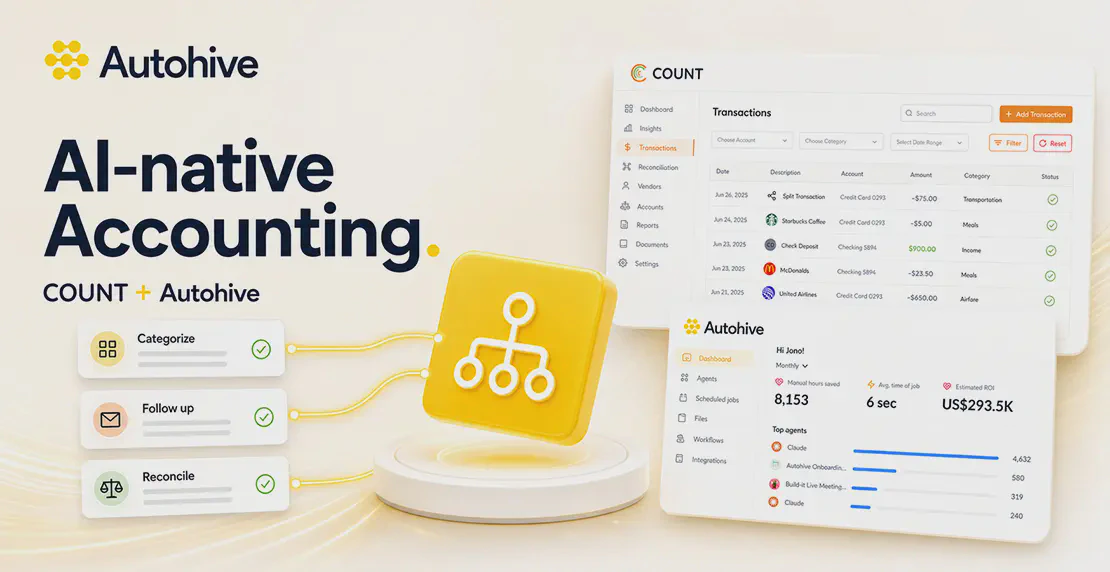
AI adoption among finance teams more than doubled in a single year, jumping from 23% to 49% between 2024 and 2025. Yet most accounting software was never built with AI in mind. It was built for a world of manual entry, plugin stacks, and rigid workflows.
That world is changing fast. David Morrison, who leads the growth of COUNT in New Zealand, sits right at the center of the shift. COUNT is an AI-native accounting system built to replace the fragmented, plugin-heavy model that has defined accounting software for the past two decades. Connect it with Autohive and the chance to rethink how finance work actually gets done becomes very real.
What’s in this article
COUNT is an AI-native accounting platform built for the modern world. Whether you run a business, a charity, or an accounting firm, it gives you a full end-to-end finance solution rather than a core system propped up by a stack of add-ons.
What makes COUNT different is what comes built in from the start:
The result is a platform that handles the back-office so you can get on with growing your business instead of wrestling with manual paperwork.
For the past 20-odd years, building a complete finance function has meant combining a core accounting system with a growing number of plugins.
That approach creates problems that pile up over time:
73% of finance professionals say their business is growing faster than their team can manage manually, which pushes automation from a future consideration to an immediate priority. The plugin model simply can’t keep pace.
COUNT deals with this by widening what a core accounting system can do for accounting practices and SMBs, and by being AI-native from the ground up rather than bolting AI onto a legacy foundation.
The numbers tell a clear story. Finance teams working alongside AI report a 48% increase in efficiency, 40% faster insights, and 38% better accuracy. By 2028, roughly 33% of enterprise software applications are predicted to include agentic AI capabilities, up from less than 1% in 2024.
The work accountants, bookkeepers, and finance teams do every day is changing at a fundamental level. As AI gets more capable, a lot of the manual work that fills the day is becoming faster and better organized.
Morrison is clear that none of this should feel like a threat. Automation gives finance professionals room to focus on the work where people add the most value: judgment, interpretation, relationship management, compliance oversight, and strategic advice.
As a16z noted in its analysis of vertical AI in accounting, the main goal for AI in this space is to take over manual, labor-intensive tasks such as data collection, transaction reconciliation, and month-end closing, the tasks usually handed to junior staff or outsourced teams. That frees senior professionals to do the work that actually needs their expertise. It also opens the door for exploring new ways for educating the next generation of accountants.
One of Morrison’s strongest points is that accountants will keep playing a vital role.
Accounting is a high-compliance industry. Businesses still need trusted professionals who understand the rules, the obligations, the risk, and the accountability. As Morrison puts it: “AI won’t go to jail for you.”
That point lands hard in the New Zealand context. Morrison and Autohive’s JD recently ran a session with emerging leaders at the Chartered Accountants Association of New Zealand, digging into how AI is changing the nature of accounting work. The message to that room stayed consistent: accountants aren’t going away, but the way the work gets done is changing in a big way.
The research backs this up. A 2025 Ipsos study on AI and the global chartered accountancy profession found the profession is set for major AI change, while upskilling, leadership, and human judgment stay central to what accountants deliver. And 61% of employees across industries say AI makes their work less mundane and more strategic.
The role of the accountant isn’t disappearing. It’s moving toward higher-value advisory work, and the teams that start experimenting with AI teammates now will be better placed to lead that change.
Morrison first came across Autohive while he was CEO of Thankyou Payroll. He was an early explorer of different AI agents and integrations, trying to work out what the emerging world of AI could mean for businesses.
Thankyou Payroll became one of the early adopters of the Autohive platform. What clicked for Morrison wasn’t only the technology. It was the idea of joining up multiple actions and systems dynamically, without having to rigidly define every step of a workflow in advance.
Autohive lets individuals and teams create, run, and manage custom AI teammates that automate repetitive operational work, with no coding required. Teams report 20 to 40% time savings in their business processes, and up to 10 hours a week reclaimed per person from manual, repetitive tasks.
For finance teams, this gets especially useful when a workflow touches the accounting system. By connecting Autohive with COUNT, businesses can move data in and out of their finance system in a natural, intelligent way, and rethinking how the work gets done (whilst maintaining human in the loop interactions) rather than just digitizing the old process.
Traditional software integrations usually involve two systems passing data between each other in a predefined way. That can be handy, but it’s often limited and brittle.
What stood out to Morrison about Autohive was something different. An AI teammate could:
This goes well beyond a point-to-point integration. It’s a joined-up system you can build and adjust on the fly. And the Autohive integrations library makes it practical, connecting COUNT to platforms like Slack, Microsoft Teams, Google Workspace, HubSpot, and dozens more without writing a line of code.
For Morrison, seeing this in action was a total game changer.
Here’s a simple, real-world example of how COUNT and Autohive work together.
A business wants to improve how it chases unpaid invoices. Using Autohive, they can build an AI teammate that:
Instead of manually checking records, writing reminders, and sending messages, the business has a governed workflow that handles the whole process. The team still sets the rules, reviews the outputs, and keeps oversight, while the repetitive manual steps get handled by your AI teammates.
That’s just one starting point. The Autohive Marketplace offers a growing library of ready-to-use agents and integrations across research, content, operations, and finance, giving teams a practical way to start building without starting from scratch.
One of the bigger shifts Morrison points to is the move away from closed, locked-down systems.
Some legacy platforms have become increasingly protective of the data sitting inside them. But that data belongs to the customer, not the software provider.
COUNT takes a client centred view. It works as a core system of record while giving customers every chance to access and use their data through whatever integrations suit them best, whether that’s the COUNT interface, Autohive AI teammates, or any other connection that makes sense for the business.
This matters because 93% of executives now say control over their AI systems, data, and infrastructure has to be part of their strategy. A platform that locks your data away isn’t a partner. It’s a liability.
COUNT’s philosophy is simple: the data in COUNT belongs to you, and you should be able to use it however you need to.
With finance data, security isn’t negotiable.
COUNT is built to be secure by design. The platform is SOC 2 Type 2 certified and includes enterprise-grade security with full encryption in transit and at rest, role-based access controls, and detailed audit logs. Those permissions carry through into COUNT’s AI and API capabilities, so when an organization connects to COUNT through an API, access is still governed by the roles and permissions defined inside COUNT.
This matters because AI-enabled workflows have to be built with control and accountability in mind. Organizations need to know who can access finance data, which AI teammates can use that data, what actions they’re allowed to take, and where a human needs to review and approve.
The Autohive integrations library follows the same principles, connecting systems through authenticated, permission-based access rather than open-ended data sharing.
By pairing automation with clear permissions and governance, businesses can explore AI-powered workflows without losing control of sensitive information.
Software products are always changing. Businesses often want new features, new dashboards, new integrations, and new ways to work with their data. But product roadmaps take time, and the feature you need today might be 12 months away.
One of the big benefits of connecting Autohive with COUNT is that businesses don’t always have to wait. Because COUNT works as core accounting infrastructure, Autohive AI teammates can interact directly with that system of record right now.
Want a custom reporting workflow? Build it. Need a process for managing unpaid bills? Set it up. Want to connect finance data to another internal system, or generate automated alerts based on accounting events? You can do that today through the Autohive Marketplace, without waiting for a vendor to add it to their roadmap.
As Morrison puts it, you don’t have to be constrained by what a system can do, because you can ask your AI teammates to build things and do work on your behalf.
For business owners and accounting firms still sitting on the fence about AI, Morrison’s message is direct: the world is changing quickly, and doing nothing is a choice with consequences.
Attending workshops and learning about AI helps, but it isn’t enough on its own. To really understand what these AI teammates can do, you have to start working with them. That means signing up, experimenting, testing workflows, and finding out where AI creates practical value in your specific context.
The point isn’t to adopt AI for its own sake. The point is to:
The businesses and accounting firms that start experimenting now will be better prepared for what comes next in finance work. And with COUNT and Autohive designed to work together, getting started has never been easier.
Ready to see what AI teammates can do for your finance workflows? Explore the Autohive Marketplace and start building the automations your business actually needs, or try Autohive today to see how your team can work better, together.

Written by
Jono is the Marketing Operations Lead at Autohive, bridging the gap between commercial strategy and AI-powered execution. With a passion for building systems that scale, he brings structure to complexity and turns marketing activity into measurable …
Zheng LiLearn how to systematically evaluate your daily tasks and discover which ones you can delegate to AI agents for maximum productivity gains through …
Read article Jono Nourse
Autohive now connects with JobAdder and Outlook Calendar, and the expanded Audit Log tracks more activity by both people and AI agents. This week also …
Read article