Most companies have done the easy part. They bought the tools, ran the workshops, maybe hired someone with “AI” in their title. And now they’re waiting for the results that were promised.
They’re still waiting.
A 2026 Writer survey found that 48% of executives describe their AI adoption as a “massive disappointment.” Nearly three-quarters say their AI strategy is more for show than internal guidance. Deloitte’s State of AI in the Enterprise puts 30% of organizations at surface-level AI use with little to no process change. McKinsey research on AI in the workplace found that almost every company invests in AI, but only 1% believe they’ve reached maturity.
This is not a technology problem. The technology works. The problem is that most organizations are trying to bolt AI onto structures that were never designed for it, and then wondering why nothing changes.
The chatbot phase
There’s a recognizable pattern to how AI adoption stalls. A team gets access to ChatGPT or a similar tool. A few people use it to draft emails faster. Someone builds a customer-facing chatbot. Leadership announces that the company is “embracing AI.” A slide deck gets made.
Then, six months later, daily AI use across the organization sits at 13%. One in ten employees strongly agrees that AI has transformed how work gets done. Twenty-nine percent of employees, and 44% of Gen Z workers, admit to actively sabotaging their company’s AI strategy.
The chatbot phase looks like momentum. In practice, it’s where most AI initiatives quietly stall.
The reason is structural. Chatbots and copilots are individual productivity tools. They make one person slightly faster at one task. They don’t change how decisions get made, how work flows between people and systems, or how the organization learns and improves over time. Deploying them at scale without changing anything else is like giving everyone a faster car and leaving the roads the same.
What redesign actually means
The organizations pulling ahead haven’t sped up their old workflows. They’ve redesigned them, changing the structures and the pace of the work itself.
That requires rethinking two things: what executives do, and what individual contributors do.
Executives as architects. The CEO, CFO, CTO, and their peers need to stop treating AI as a technology project and start treating it as an organizational design question. What processes should be automated? Where does human judgment still matter? How do we build systems that improve over time rather than just execute tasks? These are not questions you can delegate to a Chief AI Officer and forget about.
MIT CISR research on enterprise AI maturity is direct on this: successful AI scaling requires united top-level leadership, including the CEO, CIO, chief strategy officer, and head of HR. PwC’s 2026 AI business predictions confirm it: companies pulling ahead use enterprise-wide, top-down strategy, and leadership involvement in AI governance correlates directly with business value.
Hiring a single AI leader and treating it as a solved problem is an anti-pattern. It’s how organizations create the appearance of AI strategy while avoiding the actual work of it.
Individual contributors as domain experts. The value of a person in an AI-augmented organization has shifted. It used to be about executing repeatable tasks. Now it’s about judgment: knowing whether the output is right, understanding context the model doesn’t have, and building, configuring, and improving the systems that do the work.
McKinsey’s analysis of management and talent for agentic AI puts it plainly: the advantage lies with people who combine domain expertise with fluency in guiding agentic systems. Built In’s research on AI manager job skills points to delegation strategy, quality assurance based on domain judgment, and workflow architecture. Call them professional skills, not technical ones, applied to a new kind of work.
The traits that matter in this environment: domain expertise, genuine curiosity, systems thinking, integrity, and a bias for action. Not prompt engineering certificates.
The New Zealand picture
New Zealand businesses face a specific version of this problem. Eighty-seven percent of NZ organizations claim to use AI, according to data from Datacom, MBIE, and KPMG. Only 12% report scaling it across the business. Only 36% of NZ workers feel skilled enough to use AI effectively.
That gap between claiming and scaling is the chatbot phase in numbers. The tools are there. The organizational redesign hasn’t happened.
Smaller teams, which describes most NZ businesses, actually have an advantage here. They face less governance overhead, fewer centralized bottlenecks, and more room to experiment. Size isn’t really the constraint. The real question is whether leadership treats AI as a structural problem or a software subscription.
Governance as blast radius management
One of the reasons AI adoption stalls is that governance conversations go wrong in a predictable direction. Someone raises a risk. The response is a policy that restricts access. The policy creates friction. People route around it or stop using the tools. The organization ends up with the worst of both worlds: the liability exposure of unsupervised use, and none of the productivity gains from supervised use.
The 2026 Writer survey on enterprise AI adoption found that 55% of executives describe their organization’s AI use as a chaotic free-for-all, while 36% have no formal plan for supervising AI agents. These two facts coexist because blanket restriction doesn’t actually reduce chaos. It just pushes it underground.
Better governance asks a different question: what’s the blast radius if this goes wrong? A customer-facing agent that can send emails on behalf of the company has a large blast radius. An internal agent that summarizes meeting notes has a small one. The controls, scoped access and data isolation, should match the risk, not apply uniformly across everything.
Deloitte’s research on governing autonomous AI agents found that only 1 in 5 companies has a mature model for this. The organizations that get it right don’t necessarily have the most restrictive policies. What they have is clarity about where the real risks sit.
What agents actually change
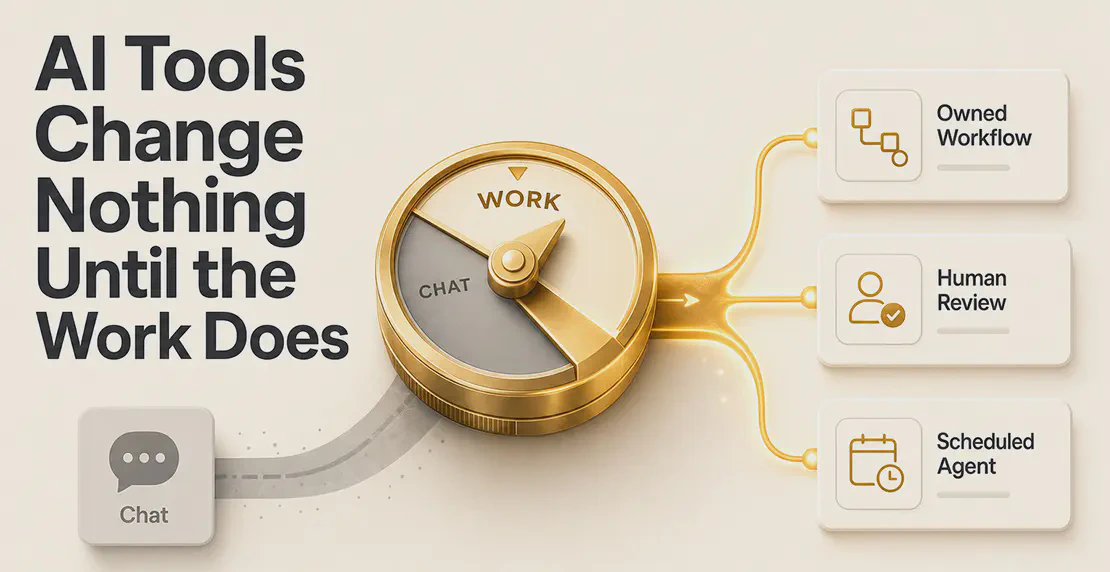
The shift from chatbots to agents is the shift from “AI helps me do a task” to “AI does work inside the systems where work happens.”
An agent connected to your CRM, project management tool, Slack, and email does more than draft messages faster. It monitors a pipeline, flags a deal that’s gone quiet, pulls context from three different systems, and surfaces it before your Monday standup, without being asked.
That’s a different category of work, and it demands a different kind of organizational thinking.
Autohive is built around this distinction. The positioning is “internal work, not chatbots.” Agents on the platform are configured with model choice, detailed instructions, business knowledge, and direct connections to the tools where work actually happens. They don’t sit in a chat window waiting to be prompted. They act.
The platform’s drag-and-drop workflow builder lets teams chain agents, tools, scrapers, database lookups, Slack and email actions, and other nodes into processes that run without manual intervention. Scheduled jobs handle recurring work: reports, monitoring, summaries, the business rhythms that currently eat time because someone has to remember to do them.
The multi-agent setup is where the organizational redesign angle becomes concrete. Multiple agents and humans work in shared threads. People can @mention agents for review, steering, or specialist input. The structure mirrors how a well-run team actually operates, with clear ownership, scoped access, and the ability to bring in the right expertise at the right moment.
What this looks like in practice
Raygun, a software monitoring company, used AI-assisted automation to reduce memory use in a data ingestion pipeline by 99.9% and improve throughput 14x. Overnight. That kind of jump doesn’t come from a faster chatbot. It comes from redesigning how the system works.
For a more detailed look at what AI-native workflow design looks like in a finance context, the COUNT/Autohive case study is a useful reference. COUNT rebuilt their accounting workflows around agents rather than retrofitting AI onto existing processes. The result is a real-world example of what it means to redesign rather than just deploy.
The AI context gap post covers a related failure mode: agents that can’t access the right information at the right time, and why that’s an organizational problem as much as a technical one.
The botsitting problem
There’s a failure mode that doesn’t get talked about enough: botsitting.
Botsitting is what happens when an organization deploys AI tools but doesn’t change the surrounding structure. Someone still has to check the output. Someone still has to copy it into the right system. Someone still has to decide what to do with it. The AI does part of the task, and a human does the rest, often spending more time managing the AI than they would have spent doing the work themselves.
This is the natural endpoint of tool rollout without redesign. The tools are there. The processes haven’t changed. The humans are now doing a different kind of low-value work instead of the original low-value work.
Better tools won’t fix this. What fixes it is building agents that encode your team’s judgment into the system, so the output doesn’t need to be babysat. An agent that knows your standards, your context, and your decision criteria produces output that’s already been filtered through your judgment, not output that needs to be checked against a mental model you’re holding separately.
That’s the difference between having an assistant and having a system.
The people side
The PwC Global Workforce Hopes and Fears Survey found that workers with the highest trust in their direct managers are 72% more motivated. Only 57% say their managers actively support skill-building. Just over half feel safe trying new approaches.
These numbers matter for AI adoption because structural redesign alone doesn’t cut it. People need to feel safe experimenting, safe failing, and safe raising concerns about AI outputs without being dismissed as resistant to change.
The 29% of employees actively sabotaging AI strategy aren’t Luddites. The strategy was handed down without their input, the tools don’t fit how they actually work, and nobody asked what would make their jobs better.
Team collaboration and role-based access matter here for practical reasons. Governance without blanket lockdown means giving people the right level of access for their role, not restricting everything because someone might misuse something. Owner, Manager, and Member roles with scoped access and shared workspaces let organizations move fast without losing oversight.
Unlimited seats also matter more than the phrase sounds. When AI tools are licensed per seat, adoption becomes a budget conversation rather than a capability conversation. The people who most need access, the ones doing the actual work, often don’t get it because the seats went to senior staff first.
Where to start
The organizations that are actually scaling AI share a few characteristics. Leadership is actively using the tools, not perfectly, but genuinely. The AI strategy is tied to specific business outcomes, not to a general mandate to “be more AI-enabled.” Governance is proportionate to risk. And the people doing the work have been involved in designing the systems, not just handed them.
None of that requires a large budget or a dedicated AI team. It requires a decision to treat AI as an organizational question rather than a software question.
If you’re starting from scratch, creating your first agent is a faster on-ramp than most people expect. The integrations page shows what’s already connectable, which is usually the first question: can this actually reach the systems we use?
The chatbot phase ends when you stop asking “what can AI do?” and start asking “how should our organization work?” Those are different questions, and only one of them leads somewhere useful.
Autohive is a no-code AI agent platform for teams that want to build internal systems, not just chat interfaces. See how it works.

Jono Nourse