Jono Nourse
- 18 Sep, 2026
What’s New This Week: 11–18 September 2026
This week's Autohive update lets you remove contacts from a HubSpot list directly, adds an HTML viewer for picking page elements and text to edit, and …
Read article
Jono Nourse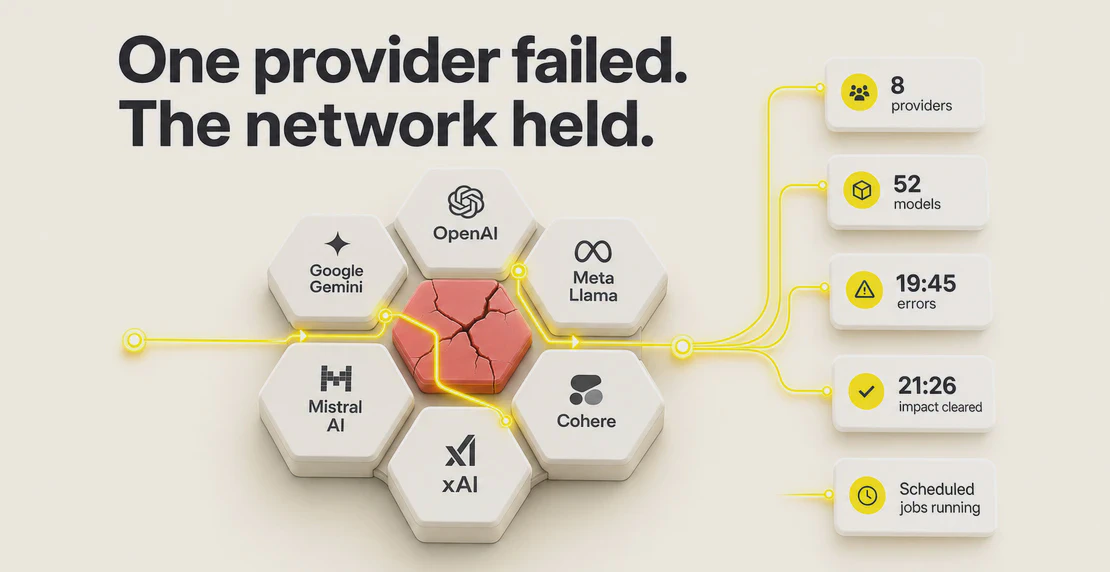
On July 29, 2026, at 19:45 UTC, Anthropic\u2019s infrastructure started showing elevated errors across all Claude models. By 20:33, the issue was identified. Primary impact ended at 21:26. Most models recovered by 21:38. Full resolution didn\u2019t land until 22:36.
Nearly three hours from first sign to full clear. The window where users would have felt it: 1 hour and 41 minutes.
Any product running on Claude’s direct API degraded for that entire stretch, with no way out. Customer support agents dropped offline. Internal tools stopped responding. Automated pipelines queued up or failed. The only option was waiting for Anthropic to fix it.
Autohive users got none of that. The routing layer caught the degradation, shifted traffic, and kept things moving.
Anthropic’s July outage is easy to point at because the status data is public. It’s one incident in a long list. Anthropic’s documented outage history spans multiple incidents across 2025 and 2026. OpenAI logged 11 incidents in 28 days during January 2026 alone.
An API reliability study covering 215+ services found that AI and ML APIs ranked last for reliability, averaging more incidents per service than any other tracked category. Every major provider, including OpenAI, Anthropic, and Google, experienced significant disruptions in 2025.
Provider outages are a baseline operating condition for AI products now. The question worth asking, before an outage happens, is what your product does when any provider degrades. Uptime records are a secondary concern.
Build on one provider and you inherit everything that provider experiences: outages, rate limits, latency spikes, pricing changes, model degradation. None of that requires a full outage to cause real problems.
A rate limit hit at peak load looks like an outage from your user’s perspective. A latency spike during a customer interaction degrades the experience whether or not the provider’s status page turns red. A price change can flip a workflow’s unit economics overnight.
Single LLM provider dependency is common because it’s simple to build. One API key, one integration, one model. That simplicity loads the risk up front. There’s no second path when the primary one fails.
This matters most for teams that have moved real workloads to AI. If your customer support agent, your internal operations tool, your content pipeline, or your developer tooling runs on a single provider, that provider’s reliability ceiling becomes your product’s reliability ceiling.
An LLM gateway or model router sits between your application and the providers. It watches health signals, tracks error rates, and routes traffic based on what’s actually working. When a route degrades, it shifts traffic to a fallback before users notice anything.
The triggers that fire a reroute cover most of what goes wrong in practice: network errors, 429 rate limit responses, 500/502/503/504 server errors, model unavailability, timeouts, authentication failures, and elevated latency. Any of those can trip the failover.
The practical effect: your application’s reliability is no longer bounded by any single provider. A two-hour Anthropic outage becomes a routing event rather than a user-facing problem.
Anthropic’s own postmortem on a separate incident showed something relevant. A bug in their direct API hit roughly 16% of Sonnet 4 requests at peak impact. The same issue’s impact on Claude via AWS Bedrock peaked at around 0.18%.
The direct API and the Bedrock path have meaningful infrastructure separation. When one has a problem, the other often doesn’t.
Autohive supports Claude through both Anthropic’s direct API and AWS Bedrock, giving customers two distinct paths to Claude. Even a provider-specific issue on the direct API doesn’t necessarily close off Claude entirely. In a broader fallback strategy, the router can also move traffic to different model families altogether if both Claude paths are affected.
Autohive connects to 8 providers: OpenAI, Anthropic direct, Google Gemini, xAI, AWS Bedrock, Google Vertex AI, OpenRouter, and Fireworks. Across those, 52 models are available.
That depth matters mainly for routing resilience. The more providers and models available, the less likely any single failure can take down a workflow.
When Anthropic’s direct API degraded on July 29, Autohive’s supplier switching moved traffic to alternative paths automatically. Teams running scheduled jobs, multi-agent workflows, and automated workflows kept running.
If your agents or workflows run on a single OpenAI or Anthropic subscription and that provider goes down, those workflows stop. Manually switching providers during a crisis isn’t a contingency plan. The infrastructure needs to handle rerouting automatically, before the crisis starts.
A routing layer with fallback isn’t hard to reason about, but it needs to be built in from the start, not retrofitted after an outage forces the conversation.
The structural requirement is straightforward: agents and workflows should point to a router, not directly to a provider. The router handles health checks, fallback logic, and rerouting. Your application stays stable when a provider doesn’t.
If you want to build agents and create workflows with this kind of resilience built in, Autohive includes supplier switching and multi-provider access across all plans.
Anthropic will have another outage. So will OpenAI, and Google, and every other provider. The incident history already proves it. The teams that won’t feel it are the ones whose architecture already accounts for it.

Written by
Jono is the Marketing Operations Lead at Autohive, bridging the gap between commercial strategy and AI-powered execution. With a passion for building systems that scale, he brings structure to complexity and turns marketing activity into measurable …
Jono NourseThis week's Autohive update lets you remove contacts from a HubSpot list directly, adds an HTML viewer for picking page elements and text to edit, and …
Read article Jono Nourse
JD Trask's Aotearoa AI Summit keynote and fresh export data point to the same conclusion: New Zealand's food and fibre, tourism, and tech sectors are …
Read article