Reilly Oldham
- 18 May, 2025
Choosing the right AI model for your Autohive agent
This guide compares the strengths and ideal use cases of major AI models available in Autohive - OpenAI for structured outputs, Anthropic Claude for …
Read article Jono Nourse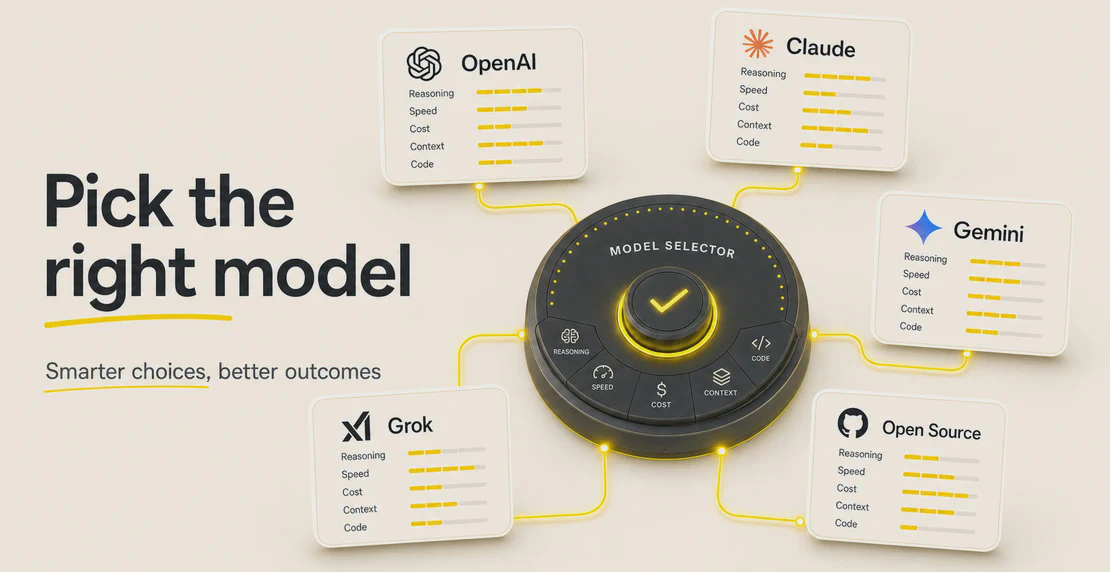
When building an agent in Autohive, you pick which AI model runs it. That choice matters. Different models are better at different things, and picking the wrong one for the job means slower results, higher costs, or outputs that miss the mark.
OpenAI, Anthropic, Google, and xAI have all shipped major updates in 2025 and 2026. There are also strong open-source options now available through Fireworks. This guide cuts through the noise and tells you what each model is actually good at. If you’re not sure where to start on model selection more broadly, our post on why one model shouldn’t run everything is worth reading alongside this one.
 OpenAI
OpenAI brought large language models to the mainstream and remains one of the most widely used providers. Their models tend to be reliable and consistent, with strong instruction-following and broad integration support. You’ve probably used them through ChatGPT or Microsoft Copilot.
 Anthropic
Anthropic was founded by former OpenAI researchers and focuses on building AI that behaves predictably and safely. Their Claude models use constitutional AI, a training approach where the model follows a set of guiding principles rather than just responding to prompts. Claude models are well regarded for analytical work, long-context tasks, and compliance-sensitive environments. Anthropic also developed the Model Context Protocol (MCP), which is becoming a standard for how agents connect to tools.
 Gemini
Google’s Gemini models are developed by DeepMind and baked into products like Gmail, Docs, and Android. They combine strong language understanding with Google’s knowledge and reasoning capabilities. Gemini models are particularly good with multimodal inputs and high-volume, document-heavy workflows.
 xAI
xAIFounded by Elon Musk in 2023, xAI has grown quickly into a serious AI lab. Their Grok models are built with less content filtering than most providers, which makes them useful for candid, unfiltered outputs. Grok also pulls real-time data from X (formerly Twitter), giving it current context that other models don’t have.
Autohive also supports a selection of open-source models served through Fireworks, a high-performance AI inference platform. These models come from different labs and offer a compelling alternative to closed-source providers, particularly for teams that want strong performance at lower cost. Because they’re open-weight, they tend to be more transparent and easier to inspect than proprietary options.
All open-source models in Autohive run through AWS. Your data never goes directly to the source labs. Requests are routed through a secure AWS environment, so the same data security standards apply here as they do across the rest of the platform.
OpenAI (GPT-5.6 Sol, GPT-5.6 Terra, GPT-5.6 Luna)OpenAI shipped the GPT-5.6 family on July 9, 2026, superseding the GPT-5.5 and GPT-5.4 line. It comes in three tiers, all sharing a 1M token context window and up to 128K output tokens per response, so the choice between them is about capability and cost rather than how much they can read.
GPT-5.6 Sol (Released July 9, 2026) OpenAI’s flagship, built for complex reasoning, coding, and long-horizon agentic work. It tops Artificial Analysis’s Coding Agent Index with a score of 80 and is noticeably more token-efficient than GPT-5.5 on coding tasks. Use it for the hardest problems you’d hand to an OpenAI model.
GPT-5.6 Terra (Released July 9, 2026) The balanced everyday option. OpenAI positions it as matching GPT-5.5 performance at roughly half the cost, which makes it the sensible default for general-purpose agents. OpenAI cut Terra’s pricing a further 20% on July 30, 2026, so that gap has only widened. See our GPT-5.6 pricing guide for the full breakdown on when to route to each tier.
GPT-5.6 Luna (Released July 9, 2026) The fastest and most affordable model in the family. Good for classification, triage, summarization, and anything high-volume where per-call cost adds up. OpenAI cut Luna’s price by 80% on July 30, 2026, which makes it worth a second look for high-frequency scheduled jobs that felt too costly to automate before. It still loses the thread on long documents and extended conversations, so keep it to short, bounded tasks.
General-purpose agents that need reliable, structured output. Email drafting, ticket triage, follow-up automation, coding tasks. Use Luna for high-volume, short-context work, Terra for everyday agents, and Sol for the hardest reasoning and coding problems.
Anthropic (Claude Opus 5, Claude Sonnet 5, Claude Haiku 4.5, Claude Fable 5)Claude Opus 5 (Released July 24, 2026) Anthropic’s flagship, replacing Opus 4.8 at the same price. Major gains on long-horizon agentic work, business process automation, computer use, and scientific research, with a 1M token context window and up to 128K output tokens per response. Read more in our Claude Opus 5 announcement, or see Anthropic’s release notes for the full benchmark breakdown.
Claude Sonnet 5 (Released June 30, 2026) The default Anthropic model in Autohive. The most capable Sonnet yet, built as a more affordable path to agentic AI. It narrows the performance gap with Opus on agentic benchmarks while keeping costs lower. A good starting point for most teams.
Claude Haiku 4.5 The fastest and most cost-effective Claude model. It handles high-volume, lightweight tasks well: triage, classification, quick summaries, simple Q&A.
Claude Fable 5 Anthropic’s other current flagship, priced above Opus 5 and built for a narrower set of jobs. In Anthropic’s own benchmark comparisons, it edges out Opus 5 on the Legal Agent Benchmark and runs close on Humanity’s Last Exam, but trails on agentic terminal coding, computer use, and business workflow automation. Reach for it on legal and compliance-heavy reasoning tasks specifically, and test it against Opus 5 before committing.
Analytical tasks, multi-step agentic workflows, structured output, compliance-heavy environments. Use Haiku 4.5 for speed and cost, Sonnet 5 for capable everyday agents, Opus 5 for the hardest agentic problems, and Fable 5 specifically for legal and compliance reasoning.
Google Gemini (Gemini 3.7 Flash, Gemini 3.6 Flash, Gemini 3.5 Flash-Lite)Gemini 3.7 Flash (Newly added) Google’s newest Flash-tier model, sitting alongside Gemini 3.6 Flash with the same 1M token context window and 65K output ceiling. It’s a refinement of the Flash line rather than a new tier, so treat it as an alternative worth testing against 3.6 Flash for your specific workload rather than an automatic upgrade.
Gemini 3.6 Flash (Released July 23, 2026) Google’s fast-tier model, and until 3.7 Flash arrived, the strongest in the Flash line. It handles coding assistance, document analysis, multimodal tasks, and production workloads well below frontier pricing. That makes it a solid default when your agent needs more than basic text work but not frontier-level reasoning. Read more in our Gemini Flash models announcement.
Gemini 3.5 Flash-Lite (Released July 23, 2026) The fastest, cheapest model in the Gemini range. Built for high-volume, low-latency work: classification, extraction, summarization, and background jobs. A strong pick for worker or subagent roles in multi-agent workflows, and for scheduled jobs where per-call cost adds up.
High-throughput agents working with long documents, CRM enrichment, knowledge base summarization, and data tagging. Use Flash-Lite for worker roles in multi-agent setups and for scheduled or recurring jobs. Between 3.6 Flash and 3.7 Flash, test both against your workload since specs are identical.
xAI Grok (Grok 4.6, Grok 4.5, Grok 4.3, Grok 4.20)Grok 4.6 (Newly added) xAI’s newest model, with a 500K token context window, up to 128K output tokens, and vision, tool use, reasoning, and streaming built into a single model rather than split across variants. The most capable Grok on Autohive right now.
Grok 4.5 Sits between 4.3 and 4.6, also with a 500K token context window and up to 128K output tokens. xAI cut cached input pricing by 40% on July 28, 2026, which matters most in longer, multi-turn agent conversations where a lot of the context is repeated rather than new. See our Grok 4.5 pricing post for the full numbers.
Grok 4.3 (Released April 2026) xAI’s established production model. 1M token context window, improved architecture over Grok 4.20, and a December 2025 knowledge cutoff. Good balance of accuracy and speed for demanding tasks.
Grok 4.20 (Released early 2026) Available in standard and reasoning variants. Introduced xAI’s reinforcement-learning-refined reasoning approach. Still usable, particularly for tasks that benefit from extended reasoning, though 4.3, 4.5, and 4.6 are now the stronger picks for most work.
Internal agents focused on ideation, feedback, team brainstorming, and anything where real-time X data or a candid tone is more useful than filtered output. Start with Grok 4.6 for the newest capability, or Grok 4.5 if your agent runs long, repeated-context conversations where the cached pricing cut pays off.
These models come from different AI labs and are served through Fireworks. They’re open-weight, meaning the model weights are publicly available. On key benchmarks, the best of these now compete directly with top closed-source models.
All open-source models in Autohive run through AWS. Your data never goes directly to the source labs. Requests are routed through a secure AWS environment, so the same data security standards apply here as they do across the rest of the platform.
DeepSeek V4 Pro (Released April 24, 2026, by DeepSeek) The top open-weight model on several coding benchmarks, including an 81% SWE-bench score. Built on a 1.6T parameter mixture-of-experts architecture with a 1M context window. NIST’s CAISI evaluation confirmed it competes with leading US frontier models across most benchmarks. A strong pick when coding performance at lower cost is the priority.
DeepSeek V4 Flash (0731 build, by DeepSeek) A faster, cheaper sibling to DeepSeek V4 Pro, tuned for terminal work, tool calling, automation, and full-stack coding. It scores 82.7 on Terminal-Bench 2.1, within 3 points of GPT-5.6 Sol, at roughly 2% of the input cost ($0.14 per million input tokens against $5 for Sol). 1M token context window and 384K max output, but no image support, so keep a multimodal model in the mix for visual tasks. Full details in our DeepSeek V4 Flash post.
Kimi K2.6 (By Moonshot AI) 1T total parameters (32B active), with a focus on agentic and coding tasks. Benchmarks place it alongside Claude Sonnet 4.6 and GPT-5.4 on coding evaluations. Solid choice for teams wanting capable open-source performance with broad task coverage.
Kimi K3 (By Moonshot AI) Moonshot AI’s newer Kimi release, with a 1M token context window, up to 128K output tokens, and image support that K2.6 doesn’t have. Worth testing against K2.6 for agentic and coding tasks where a larger context window or visual input matters.
GLM 5.2 (By Zhipu AI) Consistently ranks near the top of open-source coding benchmarks. Active development from Zhipu AI keeps it current. A reliable open-weight option with strong coding and reasoning performance.
Qwen 3.7 Plus (By Alibaba) Part of Alibaba’s Qwen 3 family. Strong across coding, reasoning, and general-purpose tasks. Broad community support and active development make it one of the more dependable open-source choices available right now.
Teams that want strong coding and reasoning capability with more transparency, or those looking to diversify away from a single closed-source provider. DeepSeek V4 Flash in particular suits high-volume, tool-heavy automation where cost per run matters. Kimi K3 is worth a look wherever K2.6 works well but the task needs more context or image input.
| Model | Best for | Example task |
|---|---|---|
| GPT-5.6 Sol | Hardest reasoning and agentic coding | Complex code generation, long-horizon agent work |
| GPT-5.6 Terra | Reliable structured output at scale | Drafting customer-facing emails |
| GPT-5.6 Luna | High-volume, budget-conscious tasks | Classifying and triaging support tickets |
| Claude Opus 5 | Deep analysis, long-horizon agent work | Complex compliance reports, multi-step research |
| Claude Sonnet 5 | Capable everyday agents at lower cost | Agentic workflows, coding, computer use |
| Claude Haiku 4.5 | Fast, cost-effective lightweight tasks | Triage, classification, simple Q&A |
| Claude Fable 5 | Legal and compliance-heavy reasoning | Contract analysis with a legal-specific edge |
| Gemini 3.7 Flash / 3.6 Flash | Fast agentic and coding tasks | Summarizing product usage logs quickly |
| Gemini 3.5 Flash-Lite | High-volume, cost-sensitive tasks | Data tagging and extraction at scale |
| Grok 4.6 | Newest xAI capability, vision + reasoning in one model | Multimodal brainstorming with real-time X data |
| Grok 4.5 | Cost-efficient long, multi-turn conversations | Extended agent sessions with repeated context |
| Grok 4.3 / 4.20 | Candid content and real-time X data | Brainstorming offbeat campaign ideas |
| DeepSeek V4 Pro | Open-source coding and reasoning | Complex code generation and review |
| DeepSeek V4 Flash | Cheap, fast agentic coding and tool use | High-volume automation pipelines |
| Kimi K2.6 / K3 / GLM 5.2 / Qwen 3.7 Plus | Open-source general purpose | Broad agentic tasks with open-weight flexibility |
As you build more agents, you’ll likely find that different models work better for different jobs. Autohive lets you switch models, test performance, and adjust as you go. The goal isn’t finding the single best model. It’s finding the right one for what you’re building right now.
We’ll keep updating this guide as new models ship. If there’s a model or provider you’d like to see supported, let us know.
Build your own AI agents on Autohive, the no-code AI platform.
These models were featured in earlier versions of this guide. They’ve been replaced by newer releases from the same providers, but you may still encounter them referenced in older agent configurations.
OpenAI: GPT-5.5, GPT-5.4, GPT-5.4 Mini, GPT-5.4 Nano, GPT-5, GPT-4.1, o4-mini, o3
Anthropic: Claude Opus 4.8, Claude Opus 4.7, Claude Opus 4.6, Claude Opus 4.1, Claude Sonnet 4.6, Claude Sonnet 4.5, Claude 3.7 Sonnet
Google: Gemini 3.1 Pro, Gemini 2.5 Pro, Gemini 2.5 Flash, Gemini 3.5 Flash, Gemini 3.1 Flash-Lite
xAI: Grok 4, Grok 3, Grok 3 Mini

Written by
Jono is the Marketing Operations Lead at Autohive, bridging the gap between commercial strategy and AI-powered execution. With a passion for building systems that scale, he brings structure to complexity and turns marketing activity into measurable …
Reilly OldhamThis guide compares the strengths and ideal use cases of major AI models available in Autohive - OpenAI for structured outputs, Anthropic Claude for …
Read article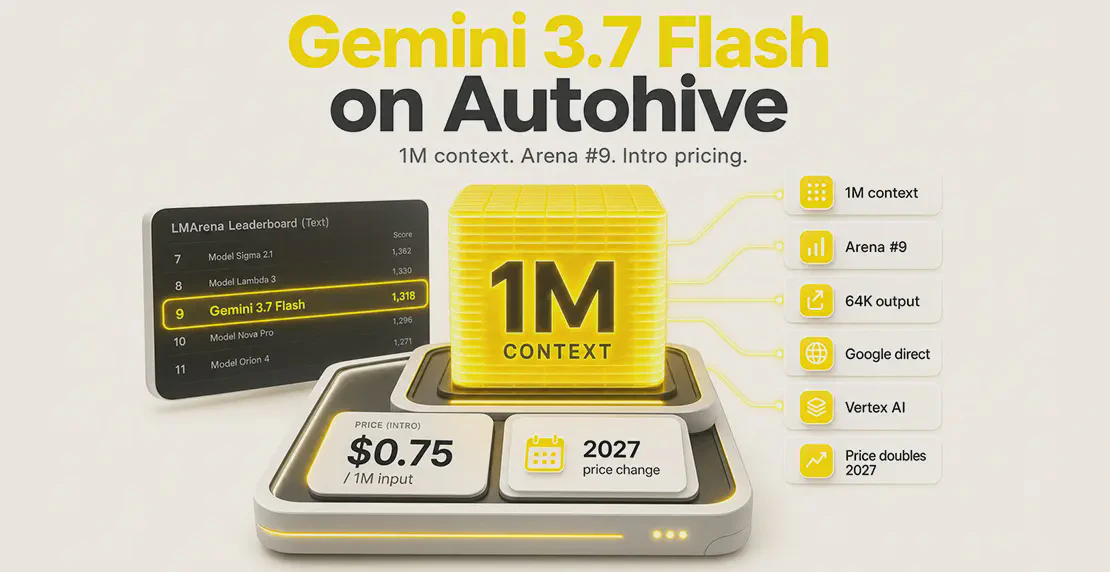 Jono Nourse
Google's Gemini 3.7 Flash brings a million-token context window and stronger agentic reasoning to Autohive at an introductory price that makes it a …
Read article