Jono Nourse
- 27 Jul, 2026
Claude Opus 5 is now live on Autohive for your hardest agent work
Assign Claude Opus 5 to the agents and workflows that need deep reasoning and long context, and keep cheaper models on everything else.
Read article
Jono Nourse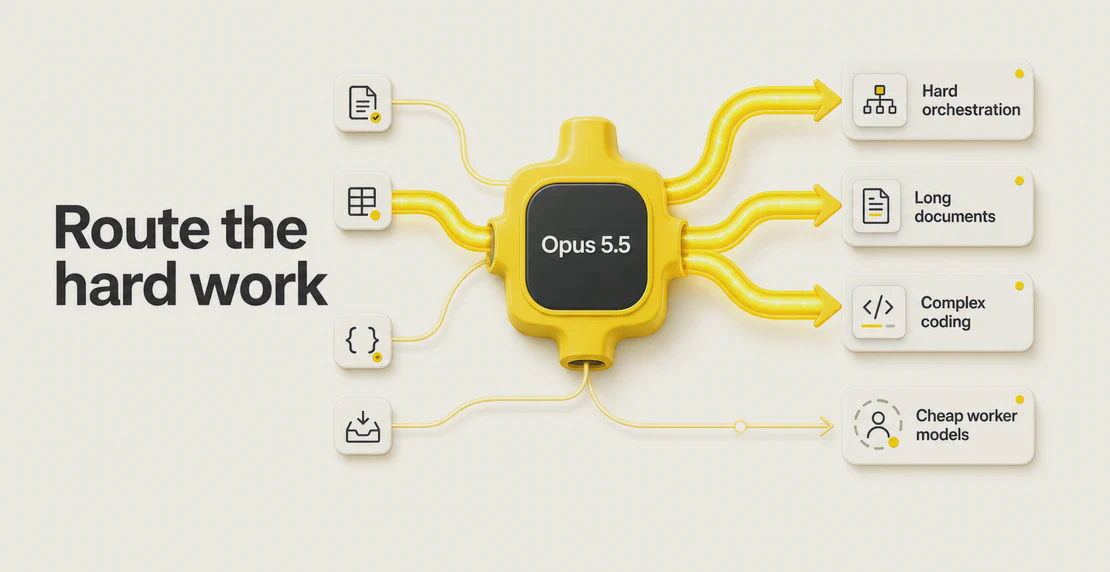
Anthropic released Claude Opus 5.5 on September 22, 2026. It’s live now in Autohive’s model catalog, and you can select it from any agent’s Optional advanced settings. Input costs $4.00 per million tokens, output costs $20.00, about 20% below Opus 5. One catch: at high effort, the model writes more, so the lower per-token price doesn’t always mean a lower cost per task.
Opus 5.5 is Anthropic’s new top-tier model. It keeps the 1M-token context window from Opus 5, drops prices, and, according to Anthropic, runs over 30% faster at matched effort. Adaptive thinking stays on by default, with effort levels from low to max available through Anthropic’s API. Autohive doesn’t expose an effort slider yet, so you can’t tune that setting from inside the platform.
The table below lists the specs as they appear in Autohive and Anthropic’s documentation.
| Spec | Claude Opus 5.5 | Notes |
|---|---|---|
| API model ID | claude-opus-5-5 | Direct Anthropic route |
| Bedrock model key | global.anthropic.claude-opus-5-5 | AWS Bedrock Global route |
| Context window | 1,000,000 tokens | Same as Opus 5 |
| Standard output ceiling | 128,000 tokens | Exposed in Autohive |
| Batch output beta | 300,000 tokens | Anthropic API only, no Autohive toggle |
| Inputs | Text and image | Vision supported |
| Outputs | Text | |
| Knowledge cutoff | June 2026 | As reported by Anthropic |
| Capabilities | Tool use, code execution, web tools, computer use, reasoning, streaming | Computer use in Autohive runs through the execution sandbox and authorized Actions, not open desktop control |
| Thinking | Adaptive, always on | Effort levels via API, not adjustable in Autohive |
Full specs are on Anthropic’s Opus 5.5 model overview. For coverage of the model Opus 5.5 replaces, see Claude Opus 5 is live in Autohive.
Prices are USD per million tokens. All figures below are current as of September 23, 2026.
| Item | Opus 5.5 | Opus 5 | Change |
|---|---|---|---|
| Input | $4.00 | $5.00 | 20% lower |
| Output | $20.00 | $25.00 | 20% lower |
| Cache read | $0.20 | $0.50 | 60% lower |
| Cache write (5 min) | $5.00 | ||
| Cache write (1 hr) | $8.00 | ||
| Batch API | 50% off input and output | Qualifying external workloads only | |
| Fast mode | $8.00 in / $40.00 out | Anthropic claims up to 2.5x speed |
The cache read drop stands out. If your agents reuse a large, stable prompt, that 60% cut saves real money. Full policy is on Anthropic’s pricing page. The fast mode figures come from Anthropic’s separate fast mode docs.
A note on Autohive billing: the platform meters usage through Usage Credits, not raw token prices. These per-token numbers describe Anthropic’s own pricing and help you reason about relative cost. For your actual spend, check the Usage tab.
Anthropic markets up to 40% lower cost per workload for Opus 5.5 versus Opus 5, a vendor claim. The per-token math backs part of that. Input and output both fell 20%, and cache reads fell 60%.
The caveat matters as much as the claim. Independent testing from Artificial Analysis found Opus 5.5 at max effort uses about 119,000 output tokens per benchmark task, against roughly 73,000 for Opus 5, about 1.6 times as verbose. More output tokens at $20 per million cut into the savings. In that high-effort setting, cost per completed task comes out close to flat despite the lower prices. Anecdotal reports on Hacker News describe max effort burning through its 128,000-token reasoning budget without returning an answer. Treat those as user reports, not measured evidence.
You save money at low and medium effort, where the token cuts land clean. Push effort to the top, and the added verbosity can cancel out the discount. Test your own workload before assuming 40%.
Model prices and specs change often. Every figure in this table is current as of September 23, 2026. Where a value couldn’t be confirmed, the cell is left blank rather than guessed.
| Model | Input | Output | Cache read | Context | Best for |
|---|---|---|---|---|---|
| Claude Opus 5.5 | $4 | $20 | $0.20 | 1M | Hard agentic coding, orchestration, long knowledge work. Watch cost and verbosity at high effort |
| Claude Opus 5 | $5 | $25 | $0.50 | 1M | Direct predecessor |
| Claude Sonnet 5 | $2 | $10 | Strong general Autohive default, better for volume and routine work | ||
| Claude Haiku 4.5 | $1 | $5 | Classification, extraction, triage | ||
| GPT-6 Sol | $2 | $10 | Cheaper agentic coding competitor | ||
| Gemini 3.1 Pro (preview) | $2 | $12 | 1M | Strong long-context competitor, preview caveat | |
| Grok 4.6 | $2 | $6 | $0.50 | 500K | Cheaper output, smaller context |
Sol pricing comes from OpenAI’s Sol and Luna launch post, Gemini 3.1 Pro pricing comes from Google’s Gemini API pricing page, and Grok 4.6 pricing comes from xAI’s model docs. Opus 5.5 is the most expensive model in this table, and it earns that cost only on the hardest work. For everything else, a cheaper model does the job just as well.
Anthropic reports these scores in its launch announcement. Treat them as vendor-reported, since Anthropic ran the tests itself.
| Benchmark | Anthropic-reported score |
|---|---|
| Terminal-Bench 4.0 (xhigh) | 66.4% |
| Humanity’s Last Exam (with tools) | 67.7% |
| OSWorld 2.0 | 81.8% partial |
| GDPval-AA v2.1 | 1,846 Elo |
Independent testing tells a different story. Artificial Analysis scores Opus 5.5 at 58 on its Intelligence Index at max effort, the highest score the lab has measured for any model. On Terminal-Bench 4.0, though, the same lab measured 59.6%, against Anthropic’s own reported 66.4%. Same benchmark, a roughly seven-point gap between the vendor and the outside lab. That gap matters for any headline benchmark. What you see in production usually lands closer to the independent number than the vendor number. See Artificial Analysis’s model comparison tool for current standings across every frontier model.
Small numbers, quick arithmetic, using Anthropic’s per-token prices.
One standard call, 100K input and 10K output 0.1M x $4 = $0.40, plus 0.01M x $20 = $0.20. Total: $0.60.
A reused 100K prompt across 20 calls, 10K output each First call around $0.70. The next 19 hit the cache at about $0.22 each. Total: $4.88, versus roughly $12 without caching. About 59% saved.
A coding agent with a stable 50K context, 20 turns, 2K new input and 3K output per turn About $1.80 with caching, versus $5.36 without. About 66% saved.
1,000 daily requests at 2K input and 500 output, over 30 days About $540 standard, or $270 through the external Batch API if the workload qualifies and can run asynchronously.
Caching and batching make Opus 5.5 affordable. Agents that reuse context see the biggest savings.
Safety testing shows a mixed picture. All of the figures below come from Anthropic’s Opus 5.5 system card.
The good. On the Gray Swan prompt-injection benchmark, Opus 5.5 held attack success at roughly 1% with extended thinking, under Anthropic’s stated test setup. That’s strong resistance for agents that read untrusted web content or tool output.
The concerns. The same system card reports the model can still be swayed by hidden instructions in pasted text, including invisible Unicode characters. That’s why Anthropic built mitigations that strip those characters and flag pasted text. Opus 5.5 also scored around 80% on the MASK honesty benchmark, lower than both Claude Sonnet 5 and Claude Opus 5. Anthropic flags evaluation awareness too: internal audits found the model recognized test scenarios in about 36% of transcripts, against 0.4% in ordinary deployment. That gap can make safety scores look better than real-world behavior.
Anthropic says it applied mitigations before release, a vendor claim. Design for the gaps anyway. If your agents paste in user-supplied documents or web text, sanitize the input, and don’t assume injection resistance covers hidden-character tricks.
Use Opus 5.5 where deeper reasoning pays back the higher price.
Good fits:
Route to a cheaper model instead:
Autohive lets you pick a model per agent. The strongest pattern is a capable orchestrator on Opus 5.5 handing lighter steps to Sonnet or Haiku. The guide to model routing walks through the logic, and the multi-agent setup guide shows how to wire the team together.
Opus 5.5 is available two ways:
Claude Opus 5.5, model key claude-opus-5-5.Claude Opus 5.5 (Bedrock Global), model key global.anthropic.claude-opus-5-5, where your workspace has AWS provider access. If your team already buys through AWS, you can also purchase Autohive on the AWS Marketplace and draw on committed cloud spend.Inside the platform you get a 1M context window, 128K maximum output, vision, tool use, reasoning, and streaming. Computer use runs through Autohive’s execution sandbox and authorized Actions, so agents act within your permissions rather than controlling a raw desktop. There’s no Anthropic Batch API toggle in the interface, and no dedicated effort slider.
This fits the work Autohive already does well: Content Hub document analysis for multi-file synthesis, GitHub and terminal Actions for coding agents, scheduled jobs for recurring runs, and multi-agent orchestration for the harder pipelines.
If you’re new to building agents, start with the custom agent guide.
Is Opus 5.5 worth it over Opus 5? For hard agentic coding and orchestration, yes. Prices are 20% lower on input and output and 60% lower on cache reads. For routine work, Sonnet 5 or Haiku 4.5 costs less and does fine.
Does the 40% cost saving really happen? Sometimes. At low and medium effort the token cuts land. At maximum effort, independent testing found Opus 5.5 about 1.6x as verbose, which can flatten cost per task. Test your own workload.
Opus 5.5 vs GPT-6 Sol or Gemini 3.1 Pro? Sol and Gemini 3.1 Pro (preview) both come in cheaper on paper as of September 23, 2026. Gemini also offers a 1M context window. Opus 5.5 targets the top of the difficulty range. The others are strong value picks for lighter agentic and long-context work.
Can I control the reasoning effort in Autohive? No. Effort levels exist in Anthropic’s API but Autohive doesn’t expose a slider today.
How is usage billed? Through workspace Usage Credits. There’s no fixed token-to-credit rate to quote here. Admins can track consumption in the Usage tab, and the billing docs cover the details.
Is there a plan or region lock? No plan-level restriction is documented in the available internal material. Access still depends on the relevant Anthropic or AWS provider route being enabled for your workspace, direct through Anthropic or through Bedrock Global on AWS.

Written by
Jono is the Marketing Operations Lead at Autohive, bridging the gap between commercial strategy and AI-powered execution. With a passion for building systems that scale, he brings structure to complexity and turns marketing activity into measurable …
Jono NourseAssign Claude Opus 5 to the agents and workflows that need deep reasoning and long context, and keep cheaper models on everything else.
Read article Jono Nourse
Grok 4.7 brings real agentic coding gains at a low per-token price, but it burns more tokens per task than 4.6, so check your real job costs before …
Read article