
Reilly Oldham
- 18 May, 2025
Choosing the right AI model for your Autohive agent
This guide compares the strengths and ideal use cases of major AI models available in Autohive - OpenAI for structured outputs, Anthropic Claude for …
Read article Jono Nourse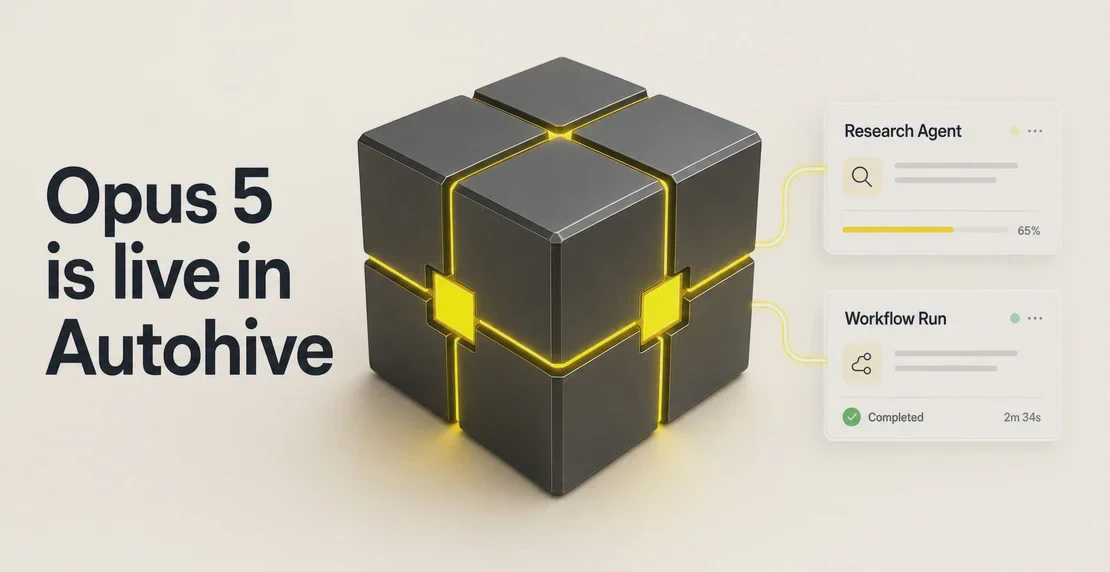
Claude Opus 5 is now available in Autohive, and you can assign it to any agent or workflow today.
Anthropic released Opus 5 on July 24, 2026 as the successor to Opus 4.8. It costs you the same as Opus 4.8 did, so upgrading an existing agent doesn’t change your cost baseline. What does change is what the model can carry: Opus 5 has a 1 million token context window, outputs up to 128K tokens per response, and supports vision, tool use, reasoning, and streaming.
In practice that means your agents can read and reason across very long documents in one pass, run longer tool chains without losing track of context, and produce detailed structured output without hitting a wall partway through. Anthropic built it for agentic work specifically: coding, multi-step reasoning, computer use, document analysis, search-heavy tasks. If your agent needs to read 200 pages of contracts, work through a 15-step workflow, or debug a codebase, this is the model built for that load.
Anthropic published benchmark results comparing Opus 5 against Fable 5, Opus 4.8, and GPT-5.6 Sol across agentic and enterprise tasks.
| Benchmark | Opus 5 | Fable 5 | Opus 4.8 | GPT-5.6 Sol |
|---|---|---|---|---|
| Agentic terminal coding, Frontier-Bench v0.1 | 43.3% | 33.7% | 21.1% | 34.4% |
| Knowledge work, GDPval-AA v2 | 1861 | 1747 | 1593 | 1736 |
| Novel problem-solving, ARC-AGI-3 | 30.2% | — | 1.5% | 7.8% |
| Agentic search, BrowseComp | 90.8% | 87.4% | 84.3% | 90.4% |
| Multidisciplinary reasoning, Humanity’s Last Exam, no tools | 56.3% | 56.5% | 49.8% | — |
| Multidisciplinary reasoning, Humanity’s Last Exam, with tools | 64.7% | 63.9% | 57.9% | — |
| Computer use, OSWorld 2.0 | 70.6% | 66.1% | 55.7% | 62.6% |
| Agentic coding, DeepSWE v1.1 | 68.8% | 69.7% | 59.0% | 72.7% |
| Agentic coding, FrontierCode v1.1 Main | 53.4% | 53.5% | 46.5% | 47.5% |
| Business workflows, AutomationBench | 26.0% | 17.4% | 17.0% | 18.1% |
| Legal, Legal Agent Benchmark held-out | 11.7% | 13.3% | 10.4% | 2.5% |
| Health, HealthBench Professional | 59.8% | 66.0%* | 57.4% | 60.5% |
| Biology, BioMysteryBench, hard | 49.4% | 46.5% | 42.4% | — |
| Biology, BioMysteryBench, human solved | 90.1% | 89.0% | 88.5% | — |
*Anthropic’s published HealthBench Professional figure in this column is for Mythos 5 rather than Fable 5.
Opus 5 doesn’t win everywhere. GPT-5.6 Sol leads on DeepSWE agentic coding, and Fable 5 leads on legal reasoning. Worth knowing before you assume Opus 5 is the right call for every task.
But the categories where it does lead map closely to what Autohive agents actually do. AutomationBench is the clearest signal: Opus 5 scores 26.0% against Fable 5’s 17.4%, Opus 4.8’s 17.0%, and GPT-5.6 Sol’s 18.1%. On business workflow automation, it separates from the field by a wide margin.
It also leads on agentic terminal coding (43.3% vs Fable 5’s 33.7% and Opus 4.8’s 21.1%), computer use (70.6%), knowledge work (1861), novel problem-solving (30.2% against 1.5% for Opus 4.8 and 7.8% for GPT-5.6 Sol), agentic search (90.8%), and tool-enabled reasoning. If your agents search the web, plan multi-step tasks, operate interfaces, or synthesize large volumes of information, these are the numbers worth paying attention to.
Autohive lets you assign a different model to each agent and workflow instead of running one model across everything. That means you can put Opus 5 exactly where it earns its cost and use faster, cheaper models everywhere else. If you haven’t thought through your model strategy yet, this post on choosing models per agent is worth reading first.
Here’s where it fits well inside Autohive:
Multi-agent setups. When an orchestrator agent coordinates several sub-agents, it handles the hardest reasoning work: planning, decomposition, reviewing sub-agent outputs, handling failures. Assign Opus 5 to the orchestrator and let Haiku 4.5 handle the simpler downstream tasks, and you get a practical balance of performance and cost.
Workflow builder. Complex workflows with branching logic, conditional steps, multiple tool calls, and multi-stage outputs need a model that can hold the full context of what’s already happened and what comes next. Opus 5’s context window and instruction-following make it a good fit here.
Scheduled jobs. Jobs you schedule to run unattended need a model that handles edge cases without breaking. Opus 5 stays more consistent under complex conditions than lighter models, which matters when no one’s watching.
Content area and knowledge base work. Agents that read from your content area and synthesize across multiple documents benefit from both the context window and the reasoning depth. Long research briefs, document comparison, policy analysis, and knowledge extraction all fit this profile.
Integrations with heavy workloads. If your agent pulls from multiple integrations and needs to reason across the combined data, the 1M context window cuts out a lot of the chunking workarounds. You can pass large API responses, document collections, or data exports straight through.
Coding agents. Opus 5’s 43.3% on Frontier-Bench v0.1 is a sizeable jump over Opus 4.8’s 21.1% and ahead of Fable 5’s 33.7%. For agents doing terminal coding, PR review, debugging, or code generation, that gap shows up in practice.
Here’s how to think about the Claude models for Autohive agents. For more detail, see Autohive’s model selection guide or Anthropic’s own guide to choosing a model.
Opus 5 is the tier for serious agentic work: complex workflows, coding, computer use, document synthesis, business process automation, multi-step reasoning at scale. At no extra cost over Opus 4.8 with noticeably better performance across the board, it’s the clear upgrade for anything Opus 4.8 was handling.
Sonnet 5 fits high-volume work that still needs solid reasoning: customer-facing agents, content generation, search summaries, anything running thousands of requests where cost adds up fast. Faster and cheaper than Opus 5, with enough performance for most everyday workloads.
Haiku 4.5 is built for speed and economy: routing, classification, quick lookups, simple Q&A, any step in a workflow that doesn’t need deep reasoning. Fast enough that latency isn’t a concern, cheap enough that volume isn’t a constraint.
Short version: Haiku 4.5 for simple tasks, Sonnet 5 for volume work, and Opus 5 for hard agentic work and complex business logic.
claude-opus-5 under the Anthropic provider and select it.If you’re upgrading an existing agent from Opus 4.8, the swap is simple and your cost baseline doesn’t move. Test a sample of your typical prompts to confirm the outputs hold up.
For complex tasks where reasoning depth and context length directly affect output quality, Opus 5 is easy to justify. But if you’re running a high-volume agent where Sonnet 5 already gets the job done, switching to Opus 5 may use more tokens without a meaningful gain in output quality.
Match the model to the task. That’s the whole point of per-agent model selection in Autohive.
Opus 5 is live in Autohive now. Put it to work on the agents that actually need it.

Written by
Jono is the Marketing Operations Lead at Autohive, bridging the gap between commercial strategy and AI-powered execution. With a passion for building systems that scale, he brings structure to complexity and turns marketing activity into measurable …
Reilly OldhamThis guide compares the strengths and ideal use cases of major AI models available in Autohive - OpenAI for structured outputs, Anthropic Claude for …
Read article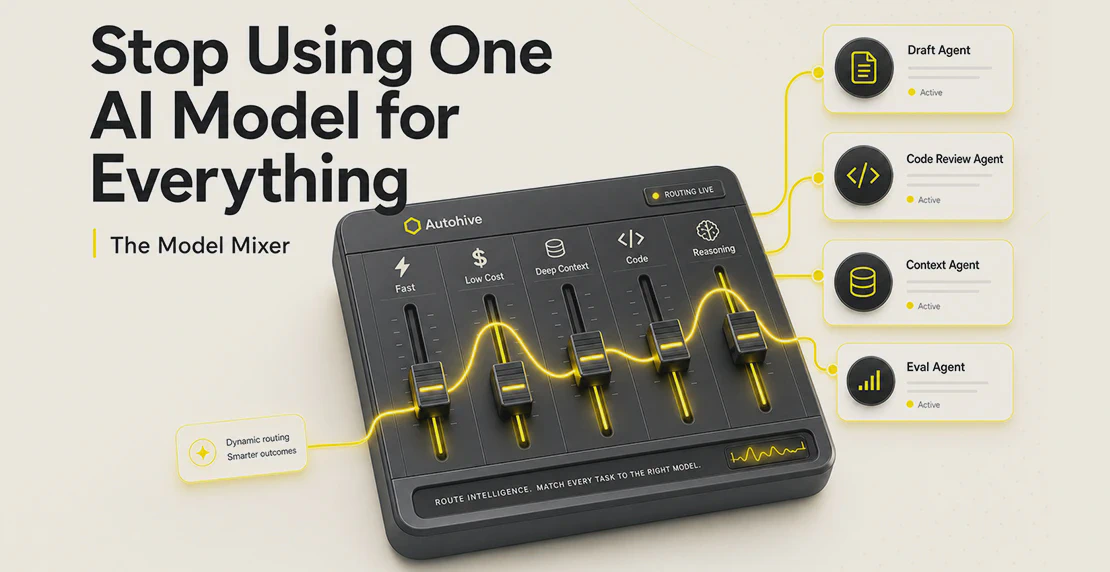 Jono Nourse
Model choice works best as an ongoing, per-task decision built into your workflow, not a single default picked once and left alone.
Read article