Jono Nourse
- 07 Oct, 2026
The Case for Risk-Based Agent Permissions
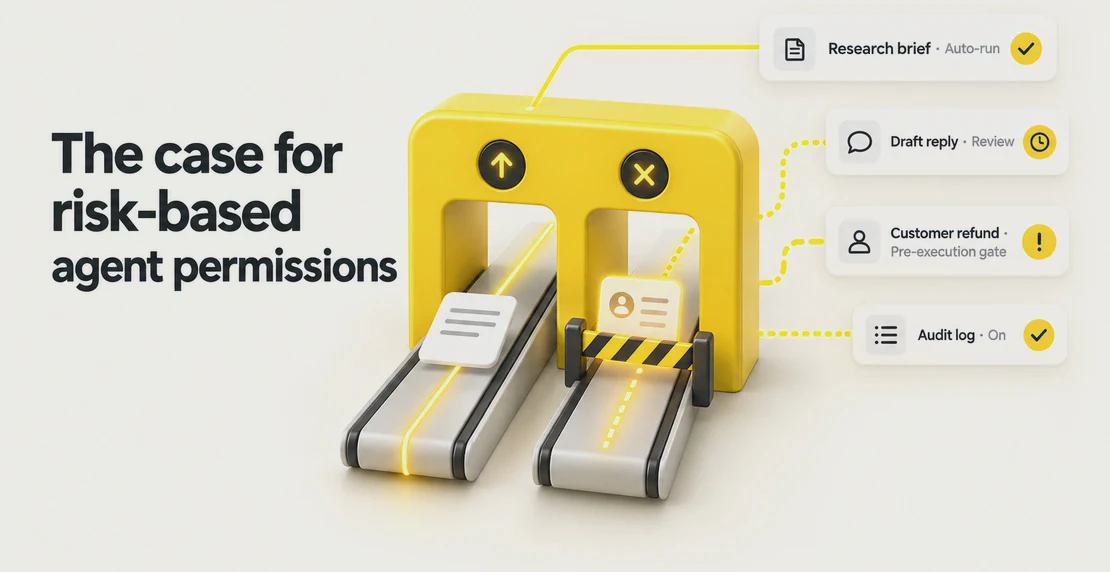
Approving every agent action leads to rubber-stamping, and treating drafts as safe misses real risk. This post shows how to set permissions by worst …
Read article
Jono Nourse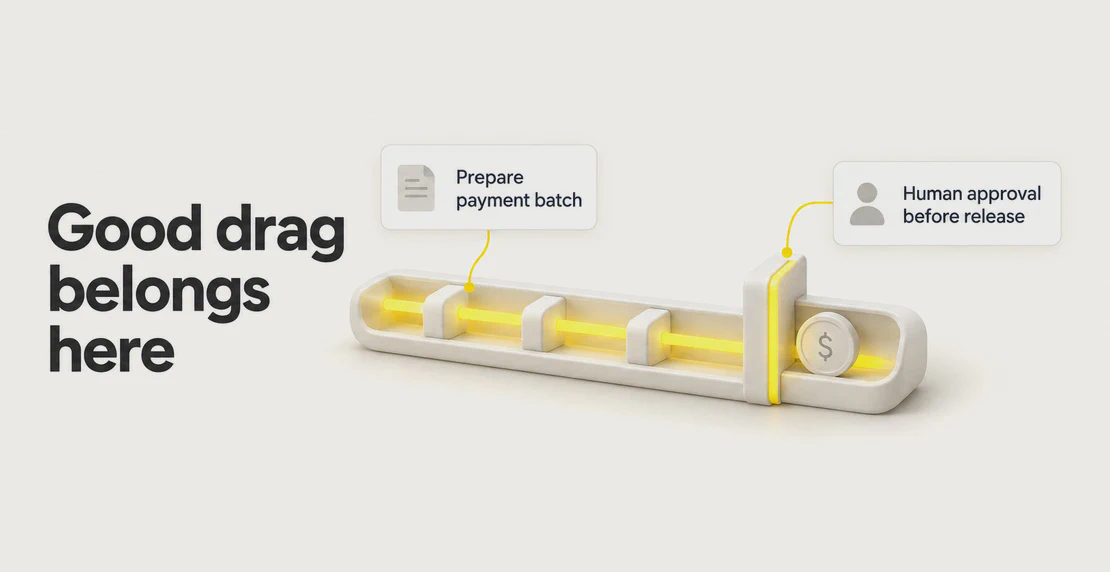
Illustration of the hypothetical accounts payable example in this article.
Sources checked 29 October 2026
Gartner surveyed more than 2,000 CIOs and technology executives in the second quarter of 2026. In Gartner’s 19 October release, carried as Business Wire copy on Morningstar, Kristin Moyer cites two results. 71% of organisations expect to deploy agentic AI within the next 12 months. Only 21% currently have agentic AI governance capabilities in place.
The release reports no cross-tab of the two. The gap is a prompt to check your own position. It doesn’t show who is deploying without controls.
Both figures come from one survey, but they measure different things. The 71% is an expectation about the next 12 months. The 21% is what organisations have today. The release doesn’t say what counted as “governance capabilities”. It also doesn’t say whether the 71% includes organisations already running agents. Fieldwork was in Q2 2026, several months before the release.
Moyer reads the two numbers together. She calls the pair “that imbalance” and says it makes it difficult to create value faster than AI creates risk. That is an analyst’s interpretation. The release includes no cross-tab and no causal test, so it can’t show that missing governance causes failures. Our earlier post on why AI rollouts stall without governance cites a different 21%, from a Deloitte survey about mature governance models. That is a separate survey and a separate measure. The narrow takeaway holds: many surveyed organisations expect to run agents soon, and far fewer report governance in place.
The same release frames the issue as a Value-Risk Flywheel, which Gartner built for AI in general. It has two forces: momentum and drag. In plain terms, momentum speeds outcomes up and drag slows them down. Daryl Plummer says “the right kind of drag can be beneficial.” Moyer says managing value and risk means “building the right kinds of momentum while avoiding the wrong kinds of drag.”
The release’s one worked example is software development, where AI frees developers from “the drag of manual coding.” That removes drag. It doesn’t show good drag being added. The release also doesn’t say where to put approvals or friction inside an agent workflow.
That step is ours. We read “good drag” as friction at the points where an action has real consequences. The release doesn’t name those points.
If some drag is useful, someone has to decide where it goes. Our view: put slow, deliberate checks where an action has real consequences, and let low-stakes steps run.
Take a hypothetical accounts payable agent, and assume three things. It can read only the invoices it is authorised to see. It can prepare a payment batch but can’t release it. Company policy says a person approves every release. Under those assumptions, matching invoices to purchase orders and preparing the batch are lower-risk steps. A bad match can still feed a bad batch. But no money has moved. Releasing the payment is the high-stakes boundary, so a human approves there.
Whether a prep step is low-risk depends on the data and permissions involved. An agent that reads sensitive records, or drafts something that commits the organisation, is already at a boundary that deserves a check. Naming those boundaries correctly is the hard part of AI agent risk management.
Critics of approvals have a point. If a person must approve every agent step, the queue becomes the delay. Our 19 August post on the approval bottleneck already made a risk-based argument: approvals should follow risk, not apply to every step.
Salesforce’s 27 October announcement describes additions to Agent Fabric, which it calls its AI control plane for managing and governing agents. As of 29 October, its availability list reads:
The page also says it may refer to unreleased features and tells customers to buy on released ones.
Salesforce describes Agent Evals as checking agents, LLMs and MCP servers in production against quality thresholds. It says they then trigger set interventions, including the Agent Kill Switch, “with approval where the team’s policy requires it.” That describes an automatic intervention, with approval added where policy asks for it. It doesn’t back our view that approvals belong only at high-stakes steps. Salesforce also frames today’s problem as the delay of “tracking down the owner and getting approval to restrict the agent.” All of this is one vendor’s design and pitch. We found no independent evidence of how well any of it performs.
A kill switch may limit further harm from an agent you suspect is misbehaving. It offers no guarantee, and it can’t undo actions already completed. If the agent has sent the email or released the payment, stopping it afterwards reverses nothing. Reversing the downstream effects is a separate job. That is why judgement belongs before the action that matters, not only after it.
No. The 71% expect to deploy agentic AI within 12 months, according to a Gartner release dated 19 October 2026, based on a Q2 2026 survey of more than 2,000 CIOs and technology executives. It’s a forward-looking expectation, not a count of live deployments. The release also gives no cross-tab with the 21%.
Drag is anything that slows an AI outcome down. Gartner’s point is that some of it helps: Daryl Plummer says “the right kind of drag can be beneficial.” Good drag is useful friction. The release doesn’t say where to place it in an agent workflow. Applying it to high-stakes actions is our interpretation.
No, not as of 29 October 2026. Salesforce lists it for general availability in January 2027. The standard Agent Kill Switch is listed as generally available, per the page dated 27 October 2026.
No. It may limit further harm, though it offers no guarantee. It can’t reverse completed actions such as a sent message or a released payment. Undoing those effects is separate work, and it needs its own process.
Disclosure: Autohive sells AI agent software. This article is our reading of public sources, not independent research. It makes no claims about how any Autohive product handles these issues.

Written by
Jono is the Marketing Operations Lead at Autohive, bridging the gap between commercial strategy and AI-powered execution. With a passion for building systems that scale, he brings structure to complexity and turns marketing activity into measurable …
Jono NourseApproving every agent action leads to rubber-stamping, and treating drafts as safe misses real risk. This post shows how to set permissions by worst …
Read article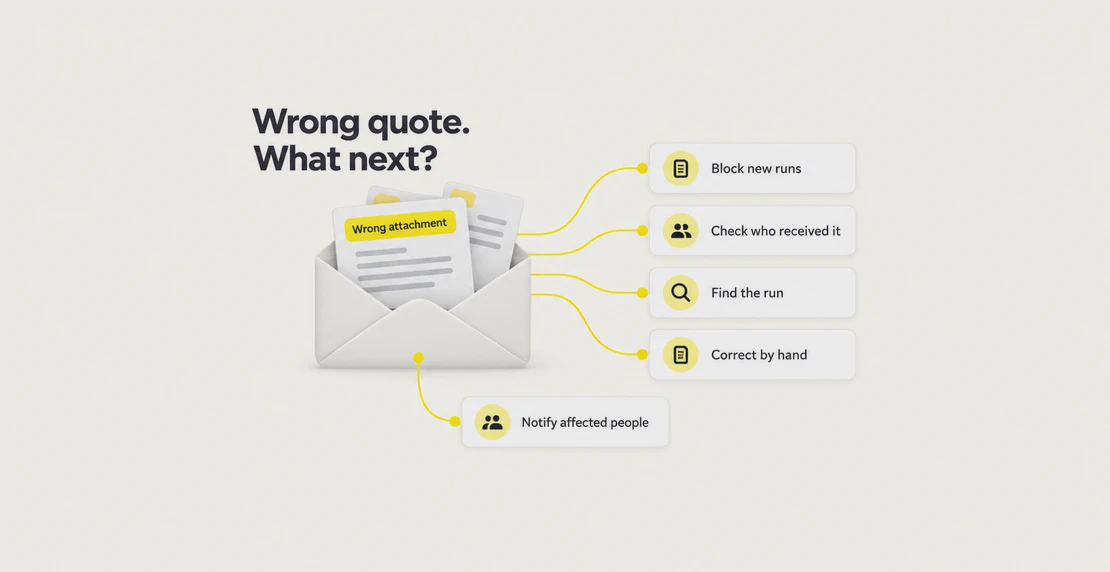 Jono Nourse
Six steps for the first hour after an AI agent makes a mistake, from stopping new runs to picking one change for this week. Written for ops teams …
Read article