Reilly Oldham
- 18 May, 2025
Choosing the right AI model for your Autohive agent
This guide compares the strengths and ideal use cases of major AI models available in Autohive - OpenAI for structured outputs, Anthropic Claude for …
Read article Jono Nourse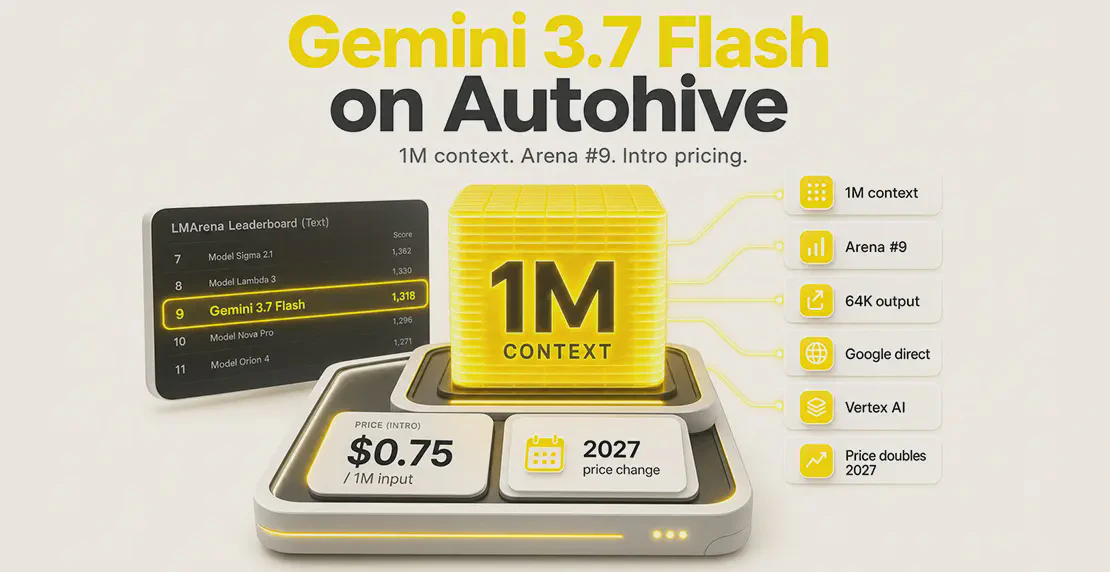
Google shipped Gemini 3.7 Flash on August 13, 2026, and it is now available inside Autohive agents through both Google direct and Vertex AI. If you build agents that read long documents, reason across several steps, or run on a schedule without anyone watching, this model is worth testing.
The short version: it handles a million-token context window, it reasons better than the Flash models before it, and the introductory price is low enough that running it on repeat jobs does not sting. There are trade-offs, and we will get to them.
Gemini 3.7 Flash is Google’s workhorse model for agentic work. It is not the most powerful model in the lineup. It is the one you reach for when you want reliable reasoning at a price that makes sense for volume. That describes most agent work: parsing files, drafting responses, running research passes, chaining tools together.
Where it improves over 3.6 Flash is in the tasks agents actually do most: multi-step work, tool use, and coding. If your agents hand work to each other, call external integrations, or follow complex instructions across many steps, this is where the upgrade shows up in practice.
On Autohive, you can assign it to any agent.
A few things are worth knowing before you switch an agent over:
| Context window | 1,048,576 tokens (1M), the top end of what Autohive supports |
| Output | Text only (reads images, audio, and video as input, but only writes text) |
| Knowledge cutoff | March 2026 (some domains limited to January 2025) |
The 1M context window is the practical headline. You can give an agent a long contract, a full codebase, or a stack of research PDFs and have it reason across the whole thing without breaking the input into chunks.
The text-only output is worth checking against your workflow. If you need generated images or audio as output, a different model fits better.
On the Chatbot Arena leaderboard, Gemini 3.7 Flash sits at #9 overall with a score of 1,490 (preliminary), ahead of Gemini 3.6 Flash at #16 and Gemini 3.5 Flash at #20.
| Model | Rank | Score |
|---|---|---|
| Gemini 3.7 Flash (High) | #9 | 1,490 |
| Gemini 3.6 Flash (High) | #16 | 1,484 |
| Gemini 3.5 Flash (High) | #20 | 1,477 |
The public Arena listing has Gemini 3.7 Flash at 1,490 +/- 8, marked preliminary, based on 5,744 battles. That score will move as more comparisons come in, but it is already a strong signal for a Flash-tier model at this price.
The deeper benchmark story is broader than the Arena score. Google’s published Gemini Flash evaluation data shows 3.7 Flash moving strongly in coding, automation, long-context retrieval, legal, biology, and video benchmarks. The Artificial Analysis Intelligence Index puts 3.7 Flash at 56 overall, close to Claude Sonnet 5 at 55 and GPT-5.6 Terra at 57.
| Benchmark | Gemini 3.6 Flash | Gemini 3.7 Flash | Claude Sonnet 5 | GPT-5.6 Terra |
|---|---|---|---|---|
| FrontierCode 1.1 Main | 34.4% | 43.6% | 42.7% | 41.3% |
| DeepSWE v1.1 | 48.6% | 65.3% | 53.8% | 69.6% |
| WebDev Arena Elo | 1,538 | 1,588 | 1,541 | 1,523 |
| Terminal-bench 2.1 | 78.0% | 85.8% | 80.4% | 87.4% |
| Terminal-bench 3.0 | 5.4% | 14.9% | 14.6% | 20.8% |
On production code quality, measured by FrontierCode 1.1 Main, 3.7 Flash edges past both Claude Sonnet 5 and GPT-5.6 Terra. The jump from 3.6 Flash is large: 34.4% to 43.6%. DeepSWE tells a similar story on long-horizon software engineering, up from 48.6% to 65.3%, though GPT-5.6 Terra still leads that benchmark at 69.6%. On web development, 3.7 Flash posts the highest Elo of the group at 1,588.
| Benchmark | Gemini 3.6 Flash | Gemini 3.7 Flash | Claude Sonnet 5 | GPT-5.6 Terra |
|---|---|---|---|---|
| AutomationBench | 17.0% | 30.4% | 10.7% | 23.6% |
| OSWorld 2.0 | 33.8% | 47.9% | n/a | 50.2% |
| Agent’s Last Exam | 24.2% | 26.3% | 33.3% | 28.0% |
AutomationBench is the strongest result for Autohive-style work. 3.7 Flash nearly doubles its predecessor at 30.4% vs 17.0%, and leads both Claude Sonnet 5 at 10.7% and GPT-5.6 Terra at 23.6%. OSWorld 2.0, which measures computer use, is close to GPT-5.6 Terra but trails by about two points. Agent’s Last Exam is weaker: Claude Sonnet 5 leads at 33.3%.
| Benchmark | Gemini 3.6 Flash | Gemini 3.7 Flash | Claude Sonnet 5 | GPT-5.6 Terra |
|---|---|---|---|---|
| HLE-Verified | 51.2% | 53.6% | 31.0% | 51.1% |
| Harvey LAB-AA (legal) | 85.1% | 90.7% | 90.1% | 85.2% |
| LABBench2 (biology) | 76.1% | 82.1% | 80.1% | 81.2% |
| BioMysteryBench (human-solvable) | 80.6% | 87.1% | 87.5% | 83.8% |
| GDM-MRCR v2 128K (long context) | 91.8% | 97.0% | 81.5% | 93.5% |
| GDP.pdf (expert PDF comprehension) | 22.0% | 34.0% | 28.0% | 24.7% |
| GPQA Diamond | n/a | 94.5% | n/a | n/a |
The long-context retrieval result is the clearest advantage in this group. On GDM-MRCR v2, 3.7 Flash reaches 97.0%, ahead of Gemini 3.6 Flash at 91.8%, Claude Sonnet 5 at 81.5%, and GPT-5.6 Terra at 93.5%. Legal and biology benchmarks are also strong. GDP.pdf remains weak in absolute terms at 34.0%, but it now leads the comparison set.
| Benchmark | Gemini 3.6 Flash | Gemini 3.7 Flash | Claude Sonnet 5 | GPT-5.6 Terra |
|---|---|---|---|---|
| CharXiv Reasoning (no tools) | 85.2% | 84.5% | 77.0% | 85.9% |
| CharXiv Reasoning (with tools) | 89.4% | 88.7% | 88.3% | n/a |
| LVBench (long video understanding) | 84.2% | 85.4% | 68.5% | 78.9% |
Long video understanding is a real strength. On LVBench, 3.7 Flash leads at 85.4%, ahead of Claude Sonnet 5 at 68.5% and GPT-5.6 Terra at 78.9%. Chart reasoning is competitive, though GPT-5.6 Terra slightly leads the no-tools CharXiv result.
The introductory Gemini API pricing for 3.7 Flash runs through December 31, 2026:
| Input (per 1M tokens) | Output (per 1M tokens) | |
|---|---|---|
| Through Dec 31, 2026 | $0.75 | $3.75 |
| From Jan 1, 2027 | $1.50 | $7.50 |
One note: the Gemini Batch API runs roughly 50% cheaper for work that does not need an instant reply.
Flag the date. On January 1, 2027, the price doubles. If you are budgeting a high-volume scheduled job into next year, plan for the change now.
That doubling probably won’t matter much in practice. Google has shipped a new Flash model roughly every six to nine months, and each one has launched at the same or lower introductory price than the last. By the end of 2026, there’s almost certainly going to be a newer, smarter Flash version available before the January 1 change even kicks in. Because Autohive lets you set the model per agent, switching is a two-click change, not a rebuild.
Autohive supports per-agent model choice, so Gemini 3.7 Flash does not have to be an all-or-nothing decision. Run it on the agents that suit it and keep others on OpenAI, Anthropic, xAI, or whatever fits the job.
The introductory pricing makes 3.7 Flash a sensible default for work that runs on repeat: a daily research digest, a nightly inbox triage, a weekly report pull. Its 1M-token context window matters here because scheduled agents often need to read a lot before they act. For setup, see how to automate jobs, scheduling your agents, and the scheduled jobs docs.
If you have built a multi-agent team where agents hand work to each other and call tools, 3.7 Flash holds up across the chain. The improvement over 3.6 Flash shows up most in this kind of multi-step, tool-using work. Mix it with other models on the agents that need something different.
Load files into the Content Hub and the 1M-token context window lets an agent reason over large knowledge bases in one pass. This suits finance, legal, and research work where the answer depends on reading the whole document, not just a snippet. Keep the PDF caveat below in mind for complex PDF extraction.
For agents that write or review code, or that chain tools together in a workflow, this model is noticeably stronger than 3.6 Flash at following multi-step instructions and recovering from errors. Pick the model per agent when you build a custom agent.
No model is free of trade-offs. Here are Gemini 3.7 Flash’s:
Gemini 3.7 Flash is available now on Autohive through both Google direct and Vertex AI. Assign it to an agent and point it at a real task: long-context research, scheduled reporting, coding support, or multi-step workflow analysis.
If you are new to model selection, start with the custom agent guide or the quickstart. For how model choice affects your credits, check pricing and your billing dashboard.
Sources: Google’s announcement, Google DeepMind model card, Gemini Flash benchmarks, Gemini API docs, and Gemini API pricing.

Written by
Jono is the Marketing Operations Lead at Autohive, bridging the gap between commercial strategy and AI-powered execution. With a passion for building systems that scale, he brings structure to complexity and turns marketing activity into measurable …
Reilly OldhamThis guide compares the strengths and ideal use cases of major AI models available in Autohive - OpenAI for structured outputs, Anthropic Claude for …
Read article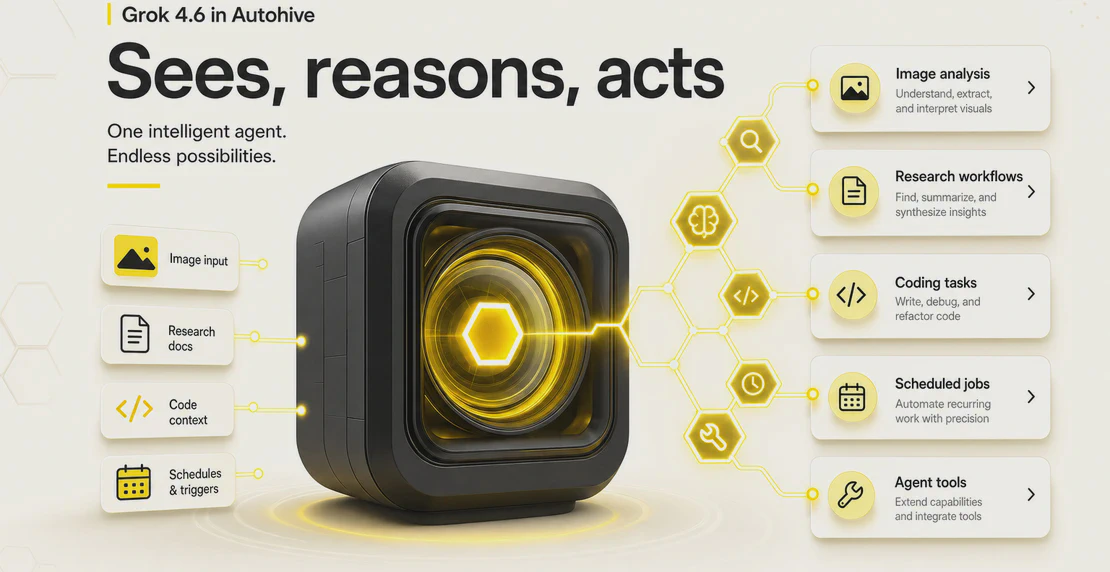 Jono Nourse
Grok 4.6 combines vision, tool use, reasoning, and streaming in a single xAI model, making it a strong default for technical and operational agents …
Read article