Jono Nourse
- 24 Jul, 2026
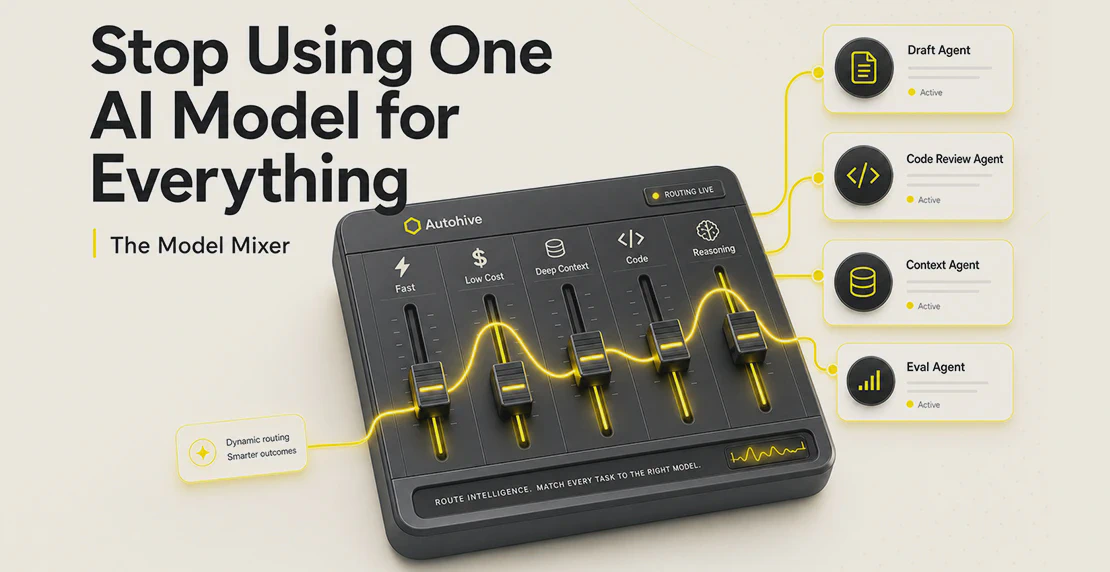
Stop Using One AI Model for Everything
Model choice works best as an ongoing, per-task decision built into your workflow, not a single default picked once and left alone.
Read article
Jono Nourse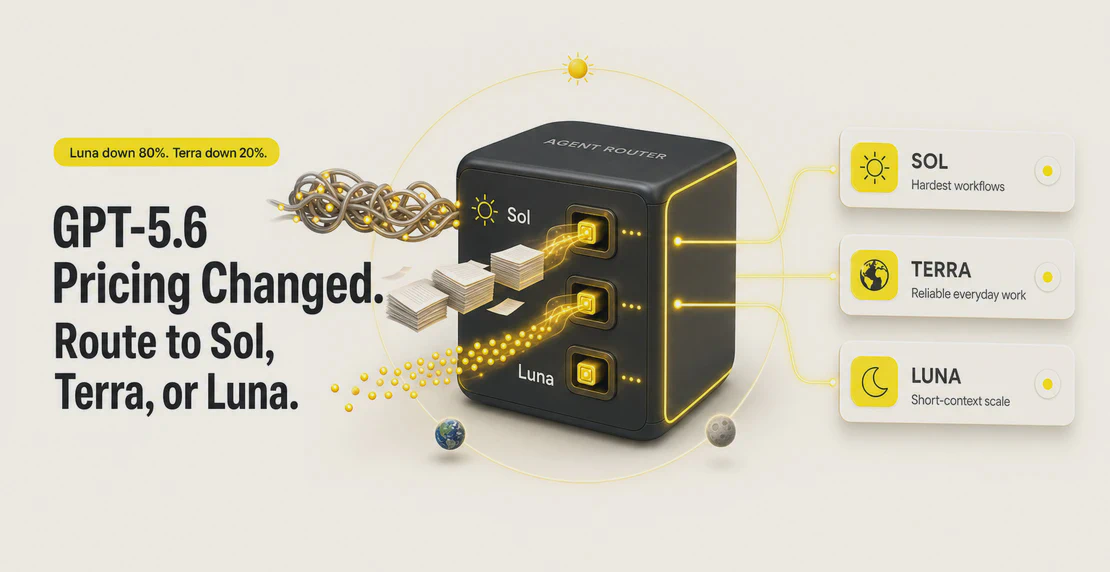
On July 30, OpenAI cut GPT-5.6 Luna’s price by 80% and Terra’s by 20%. Luna now costs $0.20 per million input tokens and $1.20 per million output tokens, down from $1 and $6 at launch three weeks earlier. Terra moved from $2.50/$15 to $2/$12. Sol, the flagship tier, is unchanged.
An 80% cut like this changes what’s economically viable to automate at scale. This piece covers what shifted, when each tier makes sense, and how to apply the new pricing inside Autohive.
| Model | Input | Output | Change |
|---|---|---|---|
| GPT-5.6 Sol | $5.00 / 1M | $30.00 / 1M | No change |
| GPT-5.6 Terra | $2.00 / 1M | $12.00 / 1M | -20% |
| GPT-5.6 Luna | $0.20 / 1M | $1.20 / 1M | -80% |
A few additional pricing points worth knowing:
The scale of the Luna reduction needs an explanation.
OpenAI attributes the efficiency gains partly to Sol itself. The model rewrote production GPU kernels in Triton and Gluon and redesigned its own speculative-decoding pipeline, cutting inference costs enough to pass significant savings down to the lighter tiers. That’s the mechanism. The motivation is competitive pressure: cheap frontier-quality models from Gemini Flash, Claude Haiku, and open-weight providers like DeepSeek have been compressing what teams expect to pay for high-volume, routine AI tasks.
The result is that Luna now runs at what OpenAI describes as year-ago frontier quality for roughly 6 cents on the dollar per task compared to Sol, at nearly 9x the throughput.
The Luna cut landed in the same week as a cached input price cut on Grok 4.5, which reduced the cost of repeated context in long Autohive conversations, where the same history, instructions, and attached documents get billed at a lower cached rate. Two providers, two price cuts, one week, both aimed at the cost of running agents at volume.
This is happening across the industry: faster hardware, leaner inference, batch pricing, and intense competition between providers are compressing per-token costs faster than most teams update their cost assumptions. If you built agent budgets six months ago, the models have gotten cheaper since. The sub-$0.30 input tier is no longer a niche option for narrow use cases.
Luna is built for high-volume, short-to-medium-context tasks where you need most of the capability at a fraction of the cost. At $0.20 per million input tokens, it becomes economically reasonable to run steps that previously felt wasteful to automate:
If you run a scheduled job that processes hundreds of records daily on a bounded, well-defined task, Luna is now cheap enough that the cost per run becomes negligible. That changes what’s worth automating.
This is the caveat that matters most.
On the MRCR benchmark (multi-round conversation recall, which tests whether a model can retrieve information from across a long context window), Luna scores 41.3%. Sol scores 91.5%. Terra scores 89.6%.
That gap is not a rounding error. It means Luna loses the thread across long documents, extended multi-turn conversations, and any context that builds across many tokens. The failure mode is subtle: Luna will produce output that looks plausible while missing information from earlier in the context. Cheaper errors are still errors, and they’re harder to spot.
Do not route Luna to tasks that involve:
The performance cliff is sharp enough that routing Luna to a long-context task will cost more in reruns, quality checks, and manual corrections than any token savings.
Terra is the practical workhorse of the three. After the cut, it sits at $2 input / $12 output, less than half the cost of Sol on input. On the Agents’ Last Exam benchmark (long-horizon agentic workflows tested across 55 professional domains), Terra scores 50.4 versus Sol’s 53.6. On coding, Terra sits at 77.4 on the Artificial Analysis Coding Agent Index versus Sol’s 80. Terra’s long-context recall is 89.6%, on par with Sol.
For most teams doing most things, Terra should be the default. It handles long context reliably, performs close to Sol on everyday agentic tasks, and costs substantially less. Sol earns its price tag on specific work: the hardest agentic tasks, complex computer use and browsing (Sol scores 92.2% on BrowseComp and 62.6% on OSWorld 2.0), advanced coding requiring Max Reasoning mode, and cybersecurity workflows.
If you’re building or reviewing a custom agent, ask whether the task genuinely needs Sol’s ceiling or whether Terra’s performance is enough. Most tasks don’t need the ceiling.
The price gap between tiers is now wide enough that routing decisions carry a real dollar cost.
A single model rarely fits every task. With a 25x difference in input costs between Sol ($5) and Luna ($0.20), assigning the wrong model in either direction has a measurable impact on cost, quality, or both.
High-frequency scheduled jobs are the clearest Luna opportunity. If your job runs nightly, or more often, against short, bounded tasks, such as parsing a structured report, tagging new records, or generating formatted summaries from a template, the context stays short and the task profile suits Luna well. Review your scheduled job configuration and check whether the model assigned to each job actually matches the task it’s doing.
The tiered pipeline pattern becomes more compelling with this pricing. Route first-pass steps (extraction, classification, initial summarization) through Luna or Terra. Pass the cleaned output to a Terra or Sol agent for reasoning, synthesis, or any step that requires sustained attention across a long context. The cost savings on the first pass don’t require any sacrifice in quality at the step that needs it.
If you haven’t set this up yet, the multi-agent setup guide walks through how to connect agents in a pipeline, and the guide to creating a workflow in Autohive covers the mechanics of wiring the steps together.
Review task profiles before defaulting to Sol. Single-purpose agents built for a specific, bounded task, such as extracting a field from a document, generating a formatted response from a template, or routing an incoming request to the right category, are good Luna candidates if the context stays short and consistent. Agents that need to track complex conversations, reason over long documents, or handle varied inputs with unpredictable context length should stay on Terra or Sol. If you’re building a new single-purpose agent for this kind of task, Autohive’s Agent Creator walks through how to put one together.
Cheaper tokens make correct routing more valuable, not less.
Running everything on Sol because it’s the safe default is a real expense at current prices. Running everything on Luna to save money is a reliability risk on any task that exceeds Luna’s context and reasoning capabilities. The right approach is the one that’s always mattered: match the model to the task, keep context tight, and don’t pay for headroom you don’t need.
Luna at $0.20 is a genuinely good option for a large, specific category of work, just not for everything.
Prompt discipline and context control still matter regardless of which tier you’re using. For Luna in particular, passing only what the model needs for each step, rather than full conversation history, keeps context short, keeps the model in its reliable performance range, and reduces cost further.
The updated pricing for GPT-5.6 Luna and Terra is live as of July 30, 2026, across the OpenAI API and supported platforms including Amazon Bedrock. If these models are available in your Autohive workspace, the new pricing applies automatically, no configuration changes required.
Pricing correct as of August 3, 2026. Verify current rates at openai.com/api/pricing before making budget decisions.

Written by
Jono is the Marketing Operations Lead at Autohive, bridging the gap between commercial strategy and AI-powered execution. With a passion for building systems that scale, he brings structure to complexity and turns marketing activity into measurable …
Jono NourseModel choice works best as an ongoing, per-task decision built into your workflow, not a single default picked once and left alone.
Read article
 Reilly Oldham
You can now register any remote MCP server as an integration on Autohive — scoped to your plan, governed by your admins, and available to your agents …
Read article