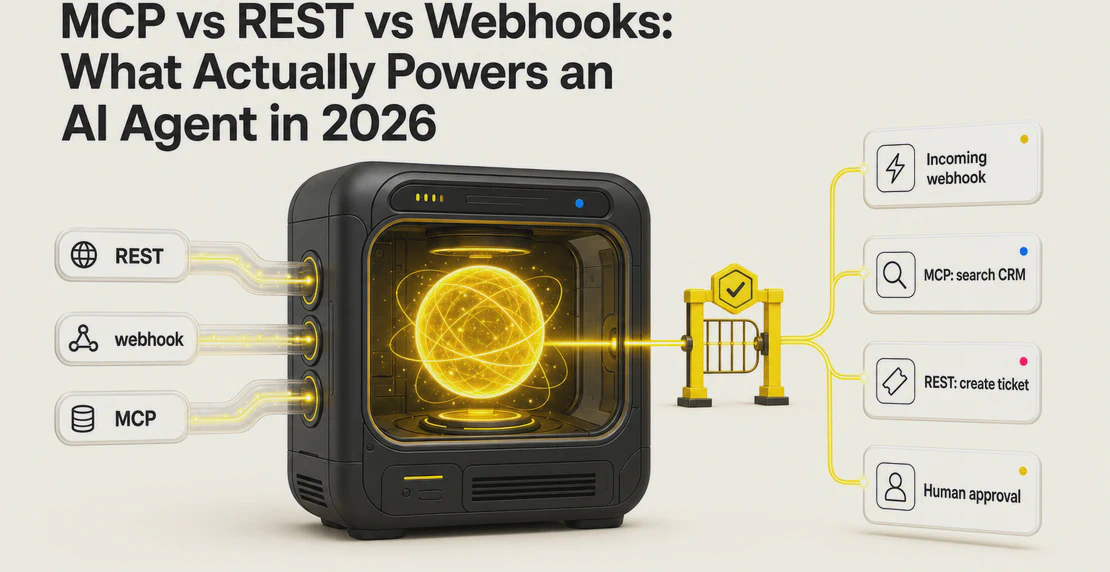
REST, webhooks, and MCP solve three different problems in the same stack. REST moves data in and out of services on request. Webhooks push a notification the moment something happens. MCP lets an AI agent discover and call tools at runtime instead of hard-coding every endpoint. They’re layers, not rivals, and most production agent systems run all three at once: a webhook fires, the agent reasons about it, an MCP tool call executes, and a REST API does the underlying work.
If you’re trying to decide MCP vs REST vs webhooks for an AI agent, the honest answer is that you rarely pick one. You decide which layer owns which job. This post covers what each protocol is, how they differ, when to reach for which, whether MCP replaces REST, whether MCP is secure, and where the standard is heading in 2026.
What is REST, and when should you use it?
REST is the workhorse for direct service operations. It’s a stateless, request-response interface over HTTP: you send a request, you get a response, and the server keeps no memory of you between calls. That simplicity is why REST scales to high throughput, and why nearly every SaaS tool ships a REST API.
Use REST when a system needs to read or write specific data on demand. Fetch a customer record, create an invoice, update a ticket, list yesterday’s orders. The caller decides when the call happens and what it asks for. If your integration is stable, direct, and high-volume, REST is almost always the right foundation. It’s also the layer that usually sits underneath everything else, including MCP tools that wrap a REST endpoint behind the scenes.
In Autohive, this maps to the API Call integration, which handles direct GET and POST requests to internal services, third-party APIs, and REST endpoints.
What are webhooks, and when should you use them?
Webhooks handle events. Instead of your system asking “has anything changed?” over and over, the source system pushes a message the instant something happens. A payment settles, a pull request opens, a form gets submitted, and a POST request lands at a URL you control.
Use webhooks when timing is driven by the outside world rather than by your code. Polling a REST API every thirty seconds to catch a new order wastes calls and adds lag. A webhook delivers that order the moment it exists. The trade-off is that you own an endpoint that has to be ready to receive, validate, and act on payloads you didn’t initiate.
This is the natural entry point for events into an agent system. In Autohive, webhooks trigger an agent or workflow from an external POST request, and the payload becomes the input the agent works with. You get inbound triggers, execution history, and webhook URL secrets so only trusted senders can start a run.
What is MCP, and when should you use it?
MCP is the tool layer for AI agents. It’s an open standard, built on JSON-RPC 2.0, that lets an agent discover what tools exist and call them at runtime. Rather than wiring each capability into the model by hand, you point the agent at an MCP server, and it reads the available tools, their inputs, and their descriptions, then invokes the ones it needs.
Use MCP when the agent, not the developer, decides which action to take. A support agent might have twenty tools available and choose three based on the conversation. That’s the real MCP vs API decision: hardcode the branching logic in REST, or hand the agent a described toolset and let it choose. The second option is what you want when the workflow is open-ended and reasoning-driven.
MCP supports several transports, including stdio for local processes, SSE, and Streamable HTTP. The 2026 direction of the standard is a stateless protocol core, which brings it closer to the request-response model REST developers already know.
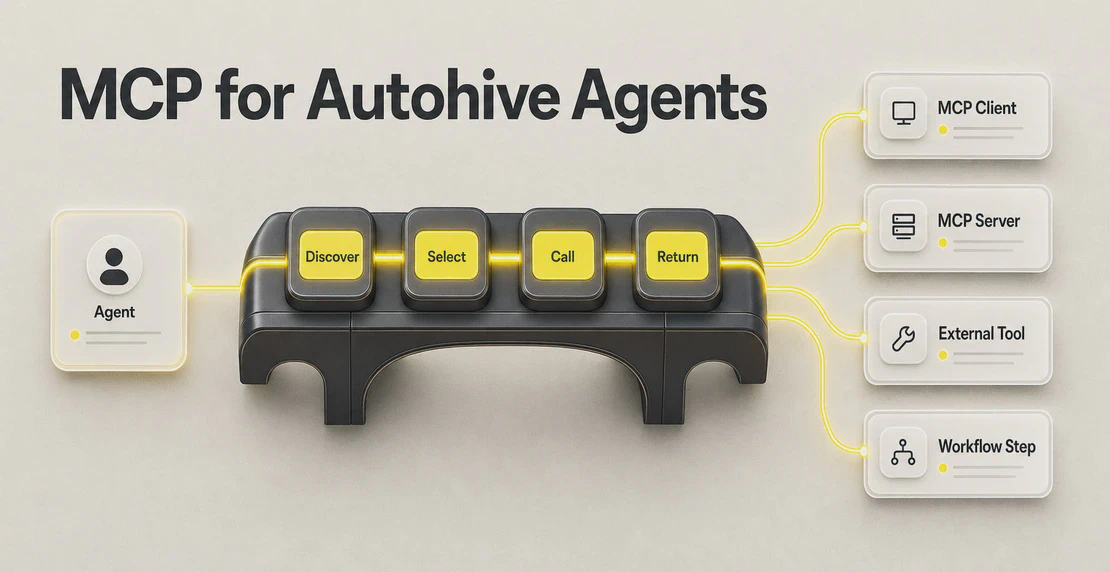
Autohive supports registering an MCP server as a custom integration through an HTTP(S) endpoint, with bearer token, OAuth 2.0, or no-auth options. Autohive discovers the available MCP tools, and you decide which ones each agent can actually use.
How do MCP, REST, and webhooks differ?
The cleanest way to keep them straight is to ask who initiates the call and who decides what happens.
| REST API | Webhooks | MCP |
|---|
| Direction | Client pulls on request | Server pushes on event | Agent pulls, chosen at runtime |
| Who decides | The developer, in code | The source system, by event | The AI agent, by reasoning |
| State | Stateless | Fire-and-forget notification | Stateless core (2026 direction) |
| Best at | Direct data operations | Real-time event triggers | Dynamic tool discovery and invocation |
| Timing | Caller’s schedule | Event’s schedule | Agent’s decision |
REST API vs MCP for AI agents isn’t a contest between old and new. REST is fixed and predictable, which matters when you already know exactly what you need. MCP is flexible and self-describing, which matters when the agent has to figure that out. MCP vs webhooks is barely a comparison at all: webhooks bring events in, MCP sends actions out. One’s the doorbell, the other’s the toolbox.
Does MCP replace REST?
Does MCP replace REST? No, and treating it as a replacement leads to bad architecture.
Most MCP tools call a REST API to do their actual work. The MCP layer gives an agent a described, discoverable way to choose an action. The REST layer performs the operation against the real system of record. Remove REST and the MCP tool has nothing left to execute against. The two operate at different heights in the stack.
Here’s the useful mental model: REST is how services talk to each other, webhooks are how services announce changes, and MCP is how agents talk to tools. When people ask whether MCP replaces REST, they’re usually noticing that it can feel like a friendlier API surface for an agent. That’s true, and it still sits on top of REST rather than replacing it. If anything, the 2026 move toward a stateless MCP core makes the relationship clearer, since both layers now share the same request-response shape.
Is MCP secure?
Is MCP secure? It can be, but the protocol doesn’t make your setup safe on its own. Most of the reported problems come from implementation choices at the tool boundary, not the spec itself. As adoption climbed through 2025 and 2026, security researchers and agencies including the NSA, Authzed, Checkmarx, and Endor Labs documented a consistent set of MCP security risks in 2026, the ones worth knowing before you connect anything to production.
- Prompt injection. Malicious text in a document, ticket, or web page tricks the agent into taking actions the user never asked for. Because MCP hands agents real tools, an injected instruction can turn into a real action.
- Tool poisoning in MCP. A tool’s description or metadata is crafted to manipulate the agent into misusing it, or a compromised server advertises a tool that does something other than what it claims.
- Command injection. A tool passes agent-supplied input into a shell or query without sanitizing it, letting an attacker run arbitrary commands.
- Over-scoped tokens. A tool is handed credentials with far more access than it needs, so a single compromised tool exposes everything the token can reach.
- Cross-tenant leaks. Weak isolation lets one customer’s agent reach another customer’s data.
- Filesystem exposure. A local MCP server with broad file access reads or writes paths it should never touch.
The pattern across the documented incidents is the same: the failures cluster around authentication, authorization, and credential handling. The defense is boring and effective. Give each tool the narrowest scope it needs, validate every input, isolate tenants, and put a human approval step in front of anything destructive.
This is where the operating layer matters more than the protocol. In Autohive, you enable or disable individual tools per agent, so an agent only ever sees the actions you granted it. Workflow approval steps gate risky actions behind a human. The audit log records what ran, and security controls cover OAuth 2.0, role-based access, TLS in transit, and AES-256 at rest. Security starts at the tool boundary, and the boundary is something you configure, not something MCP hands you for free.
Where are these protocols heading?
MCP moved fast. Anthropic launched it in November 2024, adoption grew through 2025, and in December 2025 it moved under the Linux Foundation’s Agentic AI Foundation, a signal that it’s becoming shared infrastructure rather than one vendor’s project. A July 2026 release candidate introduced a stateless protocol core, an extensions framework, JSON Schema 2020-12 support, and deprecated some earlier primitives.
The adoption signals are strong but uneven. There are more than 10,000 public MCP servers, thousands of GitHub repositories tagged mcp-server, and high SDK download volume. Production adoption numbers are inconsistent across sources, which points to fast growth with uneven enterprise maturity. In practical terms: the ecosystem is real and worth building on, and you should still treat any given server as unproven until you’ve checked its security posture yourself.
REST and webhooks aren’t going anywhere. They’re stable, understood, and sit underneath the agent layer. The real shift is that MCP is converging toward the request-response model those protocols already use, which should make the three easier to reason about together, not harder.
Choosing the right pattern in Autohive
The real design question is who controls execution, not which protocol wins. Once you answer that, the pattern falls out.
- The event brings the work. A webhook triggers an Autohive workflow or agent. Reach for webhooks when an outside system decides when work starts.
- You need a specific operation, exactly when you say so. Use the API Call integration or a connected action. Reach for REST when the step is deterministic and you already know the endpoint.
- The agent should choose the action. Register an MCP server or enable Autohive’s 100+ integrations as tools, then scope which ones each agent can use. This is when to use MCP vs webhooks: reach for MCP-style tool access when reasoning drives the decision, and webhooks when an external event does.
- The work repeats on a clock. Use scheduled jobs for one-time, daily, weekly, weekday, fortnightly, custom-interval, or end-date runs.
Connectivity is one layer, not the whole system
Picking between MCP, REST, and webhooks answers how data and actions move. It doesn’t answer who decides the order of steps, where a human signs off, what happened on the last run, or how results get back to the people who need them. That’s the layer above connectivity, and it’s where an agent stops being a demo and starts being something a team can rely on.
Autohive is built as that operating layer. Webhooks bring events in. MCP servers and integrations give agents their tools. Workflows control order, data passing, approvals, and execution history. Scheduled jobs start recurring work. Skills package instructions, scripts, files, and actions into reusable capabilities. Slack, notifications, and mobile approvals deliver results back to people. The protocols move the data. The operating layer decides what the data means and what to do about it.
If you’re wiring up your first agent, start with the boundary question: which layer owns which job, and who’s allowed to pull the trigger. Our guide to creating your first agent walks through the setup. Get the boundary question right and the “MCP vs REST vs webhooks” debate mostly answers itself.

Jono Nourse