Jono Nourse
- 17 Jul, 2026
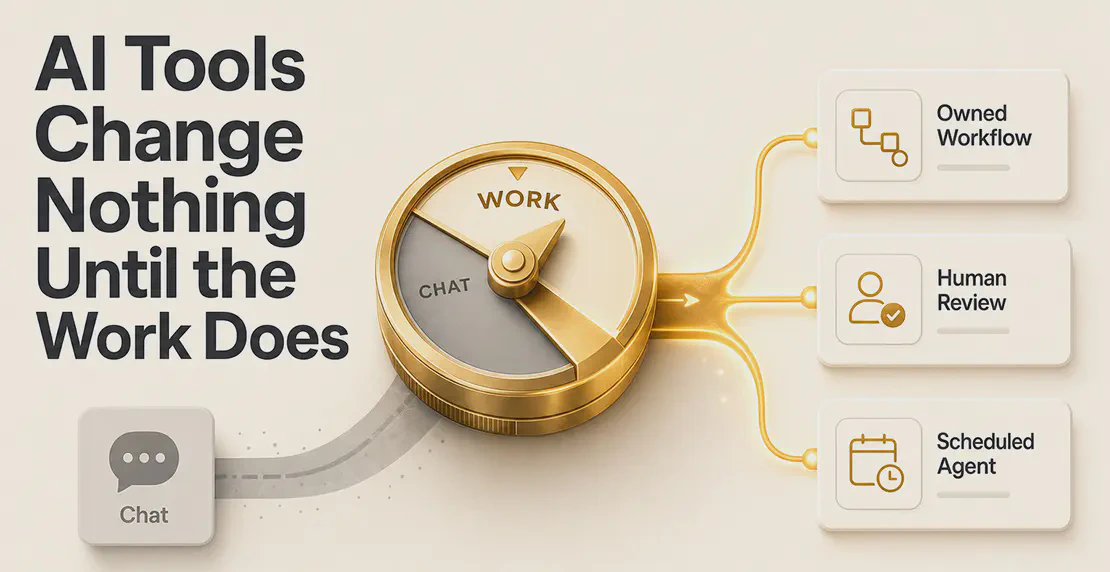
AI Tools Change Nothing Until the Work Does
Most organizations have already bought AI tools and hosted the workshops, but they're still bolting new technology onto old structures. This post …
Read article
Jono Nourse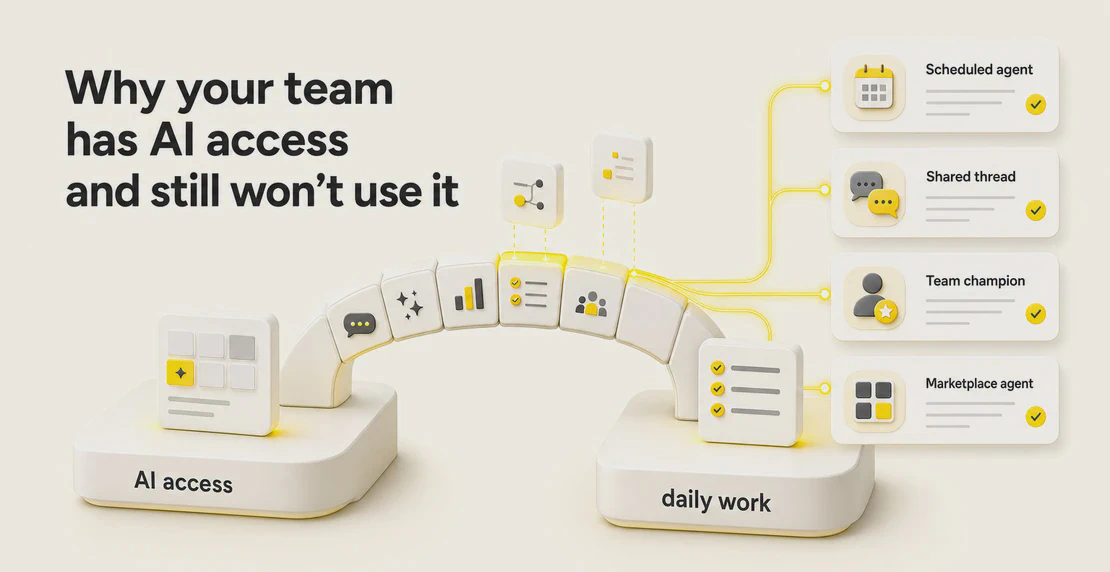
Most organizations that think they’re adopting AI are doing something else. They’ve sent people to the talks. They’ve bought a few licenses. They’ve named someone the “AI person.” Maybe they rolled out a generic tool company-wide and waited for magic.
Then nothing changes. The work still gets done the same way it did last year.
Access to AI has never been easier or cheaper. The problem is that being interested in AI and actually using it are two completely different things, and the gap between them is where most adoption efforts quietly die.
If you’re the person trying to close that gap, the founder, the operational lead, the finance manager who got excited and now can’t get anyone else to care, this is for you. You already believe. The hard part is bringing everyone else with you.
There’s a comfortable story companies tell themselves: “We’re using AI.” And on paper it’s true. Someone in marketing pastes things into ChatGPT. A few people have Copilot. The usage dashboard shows activity.
But look closer at how work actually moves through the business and you’ll find the workflows are untouched. The weekly report still takes four hours. The onboarding process still runs on the same checklist. The AI is sitting next to the work, not inside it.
McKinsey’s research keeps surfacing the same pattern: plenty of companies use AI in at least one function, far fewer scale it across the enterprise. Separate studies from EY and Writer.com point at something sharper. Lots of workers technically use AI. Only a small slice use it in a way that changes how they work. The rest are dabbling.
That’s the real divide, and it has nothing to do with who has access. Some people are watching AI. Some people are running their work through it.
When you sit in the room and listen to why people aren’t using the tools, the reasons are rarely about the technology. They’re human, and they repeat everywhere.
Fear of getting it wrong. People worry about hallucinations. They worry about “telling the AI something wrong” and getting burned. There’s a quieter fear underneath that one too: if I lean on this and it makes me look incompetent, that’s on me. Nobody wants to be the person who trusted the robot and shipped a mistake.
A bad first date. Someone tried a free tool, or a locked-down version of a corporate one, got a mediocre answer, and decided the whole category isn’t ready. First impressions stick. When people judge AI on their worst experience with the weakest tool, they write off the entire thing. A lot of what separates frustrating outputs from useful ones comes down to how you ask, but nobody learns that from one disappointing try.
The Copilot frustration. Plenty of teams got handed a license, hit blocked workflows and clunky outputs, then discovered the thing they actually needed sat behind another subscription. Now the tool is associated with friction and surprise costs, not with getting work done faster.
Budget anxiety kills experiments. The moment pricing gets uncertain, or a leader can’t see the immediate use case, the experiment gets cut. This is understandable and also self-defeating. You can’t find the use case without experimenting, and you can’t experiment if every trial has to justify itself before it starts.
The single-owner trap. Appointing one “AI owner” feels like progress. Usually it creates a bottleneck. That person becomes the help desk, the gatekeeper, and eventually the reason nobody else builds the muscle. Adoption research is pretty consistent here: champions work best when they’re spread across teams, not concentrated in one job title.
The event-to-action gap. People attend the AI talk, feel inspired, go back to their desk, and do nothing until the next event. Awareness goes up. Behavior doesn’t. Attending a talk about swimming is not swimming.
Notice what’s missing from that list. Almost none of it is technical. The friction lives in mindset, proficiency, and habit. Which means the fix does too.
If the blockers are mostly about how people think, then adoption is a mindset problem before it’s a tooling problem. Three shifts do most of the work.
A demo shows you what’s possible. A workflow changes what you do on a Tuesday. The whole game is moving AI from “the thing I open when I remember” to “the thing that runs whether I remember or not.”
That means picking one real task, not a generic use case, and rebuilding it around AI. The evidence backs this: workflow redesign predicts AI value far better than tool access alone. Giving everyone a login and hoping is the most common way to spend money on AI and get nothing back.
Stop looking for the AI person. Start building AI capability in the people who already own the work. The finance manager knows what’s broken in finance. The ops lead knows where the weekly grind is. When the people who understand the problem can build the solution, you get useful, specific tools instead of one overloaded owner fielding requests.
Distributed champions also solve the trust problem. People believe a colleague who shows them something that worked far more than they believe a mandate from above.
Early AI spend behaves more like training than infrastructure. You wouldn’t expect a new hire to return measurable ROI in week one, and you shouldn’t expect it from a team learning a genuinely new way to work either.
Treat the first few months as learning and development. The return comes from capability that compounds: people who get fluent, find their own use cases, and teach the next person. Demand a spreadsheet-clean payback on day one and you’ll cancel the experiments right before they’d have paid off.
The longer view helps here. Treat AI less like a product one person owns and more like electricity. Nobody has a meeting about whether to adopt electricity. It’s just part of how everything works. That’s the destination, even if you’re nowhere near it yet.
You cannot remove blockers you’ve never hit. Leaders who’ve never actually built something with AI can’t tell the difference between a real obstacle and an excuse, and they can’t coach a team through the awkward early phase. Hands-on beats hands-off every time. Spend an afternoon building one thing yourself before you ask your team to.
Skip the abstractions. Here’s one that’s concrete.
Every week, someone on the ops team pulled data from Google Calendar and a spreadsheet to check who was overbooked. It took an hour, it was boring, and it got skipped whenever things got busy, which was exactly when it mattered most.
They rebuilt it as an agent. Now it runs on a schedule, checks the calendars and the sheet, flags anyone sitting at 120% booked capacity, and posts the result where the team can see it. Nobody has to remember to run it, and nobody has to do the manual pull. The work happens whether anyone’s thinking about it or not.
That’s the whole difference between using AI occasionally and having it run on its own schedule, not yours. One task, done in the open, running without anyone having to remember it. That’s a pattern you can copy, not a demo you can only admire.
We built Autohive after living this problem inside our own company. Raygun is an engineering-heavy business full of people who are comfortable with technology, and even there, getting AI genuinely adopted was harder than it should have been. If it’s hard for a room full of engineers, it’s hard for everyone.
So we built around the adoption problem, because access to AI was never the hard part.
A few things follow from that:
Unlimited seats on every plan. The “who gets AI access?” negotiation is a great way to stall adoption before it starts. So we removed it. Every plan includes unlimited seats.
The people closest to the work build the tools. With the Agent Creator you describe the job and Autohive helps you build the agent around that specific task, not a generic chatbot you have to wrestle into shape. And you don’t need to be a prompt engineer to write instructions that work.
AI that shows up on its own. Scheduling and workflows mean agents run proactively instead of waiting for someone to remember they exist.
Work that happens in the open. Humans and agents collaborate in shared threads, so AI work is visible to the whole team instead of hidden in one person’s private chat window.
Champions spread, not bottleneck. When someone builds something good, they share it in the Autohive Marketplace and every colleague benefits without rebuilding it from scratch.
Help after login. White-glove onboarding, training, and support, because the login was never the hard part.
Don’t roll out AI to the whole company on Monday. Do this instead.
Pick one task you already do every week, one that’s manual and slightly annoying. Build an agent for that single task, or invite your team and structure how they’ll work with agents if you want a few people learning at once. Get it working. Show someone. Let them see the boring thing disappear.
Then do it again with the next task. That’s how watching turns into using. Not through another talk, but through one real thing that works, and then the next.
You’re already convinced. Now go build the first one.

Written by
Jono is the Marketing Operations Lead at Autohive, bridging the gap between commercial strategy and AI-powered execution. With a passion for building systems that scale, he brings structure to complexity and turns marketing activity into measurable …
Jono NourseMost organizations have already bought AI tools and hosted the workshops, but they're still bolting new technology onto old structures. This post …
Read article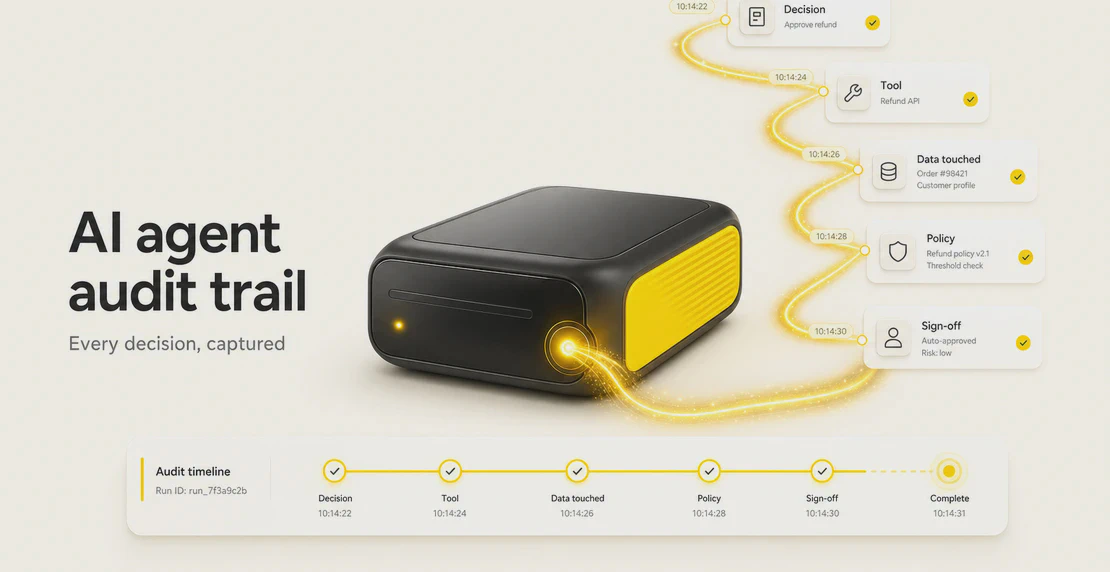 Jono Nourse
Most agent logs cannot answer basic questions about what an AI agent did, why, or who approved it. This post breaks down what a real audit trail …
Read article