
Jono Nourse
- 06 Aug, 2026
Autohive Is New & Noteworthy in the Xero App Store: What You Can Automate Now
Autohive is now in Xero's New and Noteworthy collection. Here's what's available to automate once your Xero account is connected.
Read article
Jono Nourse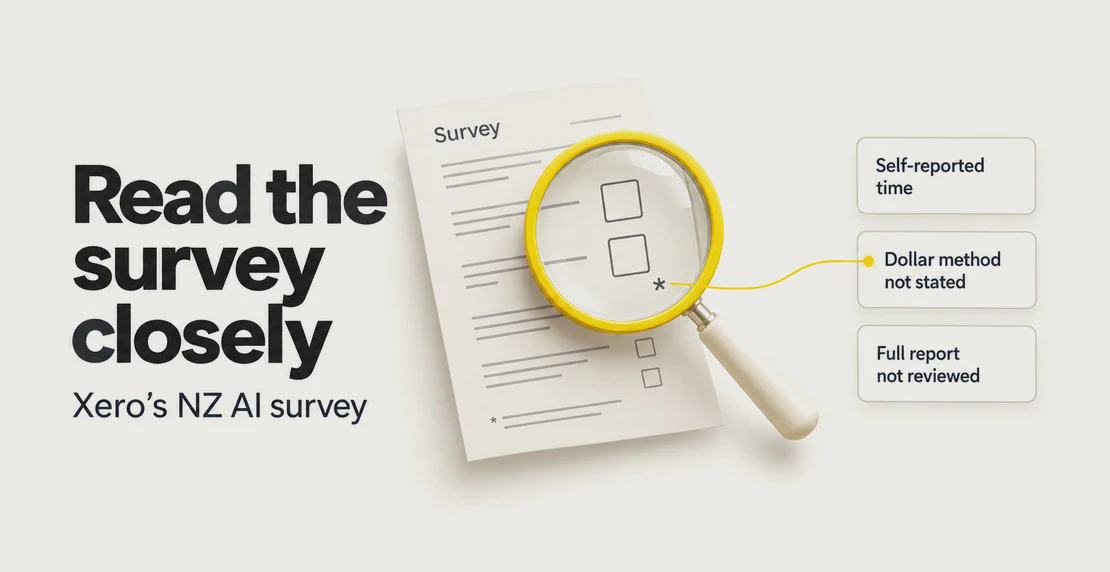
Xero says AI tools save New Zealand accounting and bookkeeping practices an estimated $145,000 a year, across all their staff. That claim comes from Xero’s 12 October 2026 media release. The release says its time savings are self-reported and worked out from the midpoint of banded answers, giving seven hours a week across all staff combined. It doesn’t explain how the dollar figure was built.
The numbers come from Xero’s Modern Practice Playbook for Aotearoa New Zealand, a survey of 526 senior accounting and bookkeeping professionals. Xero commissioned the research. Commissioning a survey isn’t the same as running it, so who handled the fieldwork is a fair question.
The scope here is the media release, which anyone can read, plus the public landing page for the playbook. The full report sits behind a registration form that asks for contact details, and this analysis didn’t review it. Nothing here invalidates what the release reports. It sets out what the release does and doesn’t say.
Xero’s release says the survey covered 526 respondents in New Zealand. Of those, 266 came through third-party panels and 260 came from the Xero customer database. The data was weighted so each practice-size segment made up 25% of the sample.
That is the clearest method detail in the release. It doesn’t name the practice-size bands, the fieldwork dates, the invitation method or the response rate. It doesn’t give unweighted counts for each segment either.
Two recruitment routes can bring selection bias. Xero customers and panel members may differ from other practices in ways the release doesn’t reveal, and it gives no way to tell which direction any difference runs.
Equal 25% weighting is a design choice. It gives each size band the same say in the totals. It doesn’t show that the sample matches the real mix of practice sizes in New Zealand. The release also doesn’t confirm that the 526 respondents come from 526 different firms.
Xero reports that 49% of practices are actively using AI in their day-to-day workflows. The release doesn’t define actively using, so we can’t tell what a respondent had to be doing to be counted. Day-to-day workflows isn’t necessarily the same as daily use.
The release also refers separately to practices using AI every day, in the documentation finding below. That group isn’t necessarily the same as the 49%, and subgroup counts aren’t given, so the two shouldn’t be merged. We also can’t confirm how the weighting applies to the 49%.
Xero says AI tools save practices seven hours a week across all staff combined. The wording is “saves practices seven hours per week”, so it reads as a practice-level figure, not seven hours per employee. The release says the time figures are self-reported estimates, calculated from the midpoint of banded responses.
Banded means a respondent picks a range instead of typing an exact number. The analyst then uses the middle of the range. As a purely hypothetical example, someone who picks five to ten hours would be counted as seven and a half. The release doesn’t publish the actual bands, so we can’t see how wide they were.
Because the figure is a combined total, it doesn’t show how the time was spread across staff or across practice sizes. The release also doesn’t say whether the seven hours is a mean or a median.
The release doesn’t establish that $145,000 is cash, profit or return on investment. It reports the number without the working behind it.
Here is the central claim in Xero’s own words: “Across all staff combined, the use of AI tools saves practices seven hours per week and an estimated $145,000 in monetary savings per year.” The release says AI “saves practices” that amount. That reads most naturally as per practice, per year, across all staff, but the release never says “per practice” outright.
Xero’s release also reports a higher figure for what it calls top performers: 10 hours a week and $200,000 a year. It defines them as practices with two or more full-time employees and a net profit margin of 41% or above. The release subhead leads with “up to $200k”, and the playbook landing page leads with $200,000 too. This article looks only at the $145,000 and doesn’t assess the top-performer figure.
The release doesn’t confirm a currency code. It doesn’t show the formula, say whether the figure is a mean or a median, or state whether the estimate covers only AI users or the whole sample.
The midpoint method applies to the time figures. The release doesn’t say the dollar figure was calculated from those hours, so we shouldn’t assume hours were converted into money.
Time freed and money saved can be different things. Saved time can show up as spare capacity, as value to clients, as lower costs or as higher revenue. Each is a separate claim. Without the method, there’s no way to tell which one the $145,000 reflects. Read it as Xero’s reported estimate rather than a confirmed profit or bank balance.
Autohive’s piece on why capacity beats cost-cutting in AI strategy sets out one way to read time savings like these. It is an argument about where AI value lands, and it doesn’t test Xero’s number.
Xero reports that 89% of practices using AI every day say their core processes are well documented, against 30% of practices not using AI. That is a wide gap. It shows the two things occur together. It doesn’t show which one drives the other. The release doesn’t establish which came first.
Several explanations fit, and each is a hypothesis. Practices that already documented their processes may have found AI easier to adopt. Using AI may have pushed practices to write their processes down. A third factor may sit behind both. Well documented is also the respondent’s own judgement, not an audited measure.
Autohive has argued that tools change little until the underlying work changes. That is a general view on AI adoption, and it isn’t evidence for either direction here.
The same questions work on most research a vendor publishes about its own market. Here they are, with what Xero’s release says on each.
Press coverage repeating the same release isn’t independent confirmation, because it draws on one source.
The release reports a few things clearly. Xero says 49% of practices are actively using AI in their day-to-day workflows. Respondents report time savings. A higher share of daily AI users than non-users say their processes are well documented. These are Xero’s reported results.
The release doesn’t show that $145,000 is cash in any practice’s account, that AI caused the documentation gap, or that the figures describe every New Zealand practice. For the wider context, Autohive has written about the New Zealand small-business AI opportunity. It is separate evidence, and it doesn’t validate or test this survey.
Source and access note: This analysis draws on Xero’s media release dated 12 October 2026 (published in Wellington) and the public landing page for the Modern Practice Playbook for Aotearoa New Zealand. The full report is behind a registration form and was not read for this piece. The central savings sentence is quoted directly in the dollars section. All other figures and definitions are paraphrased from the release, except the landing page’s $200,000 line.
Disclosure: Autohive has a listing on the Xero App Store, listed “By Autohive”. The listing was live as at 22 October 2026. Autohive has a commercial interest in how this market is discussed.

Written by
Jono is the Marketing Operations Lead at Autohive, bridging the gap between commercial strategy and AI-powered execution. With a passion for building systems that scale, he brings structure to complexity and turns marketing activity into measurable …
Jono NourseAutohive is now in Xero's New and Noteworthy collection. Here's what's available to automate once your Xero account is connected.
Read article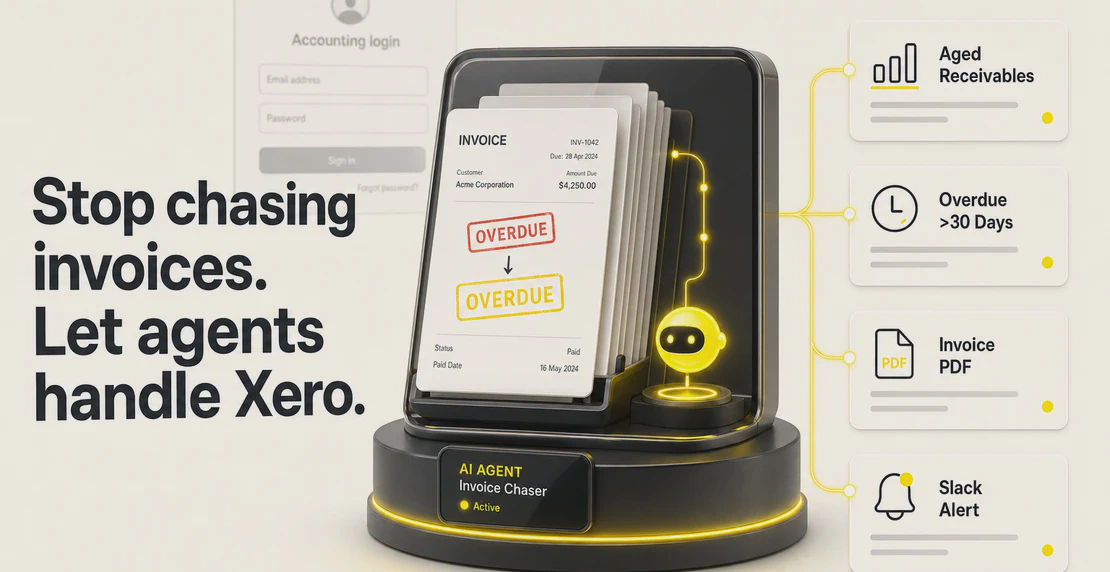 Jono Nourse
Autohive's new Xero integration puts 26 actions in the hands of custom AI agents, from chasing overdue invoices to running scheduled financial …
Read article